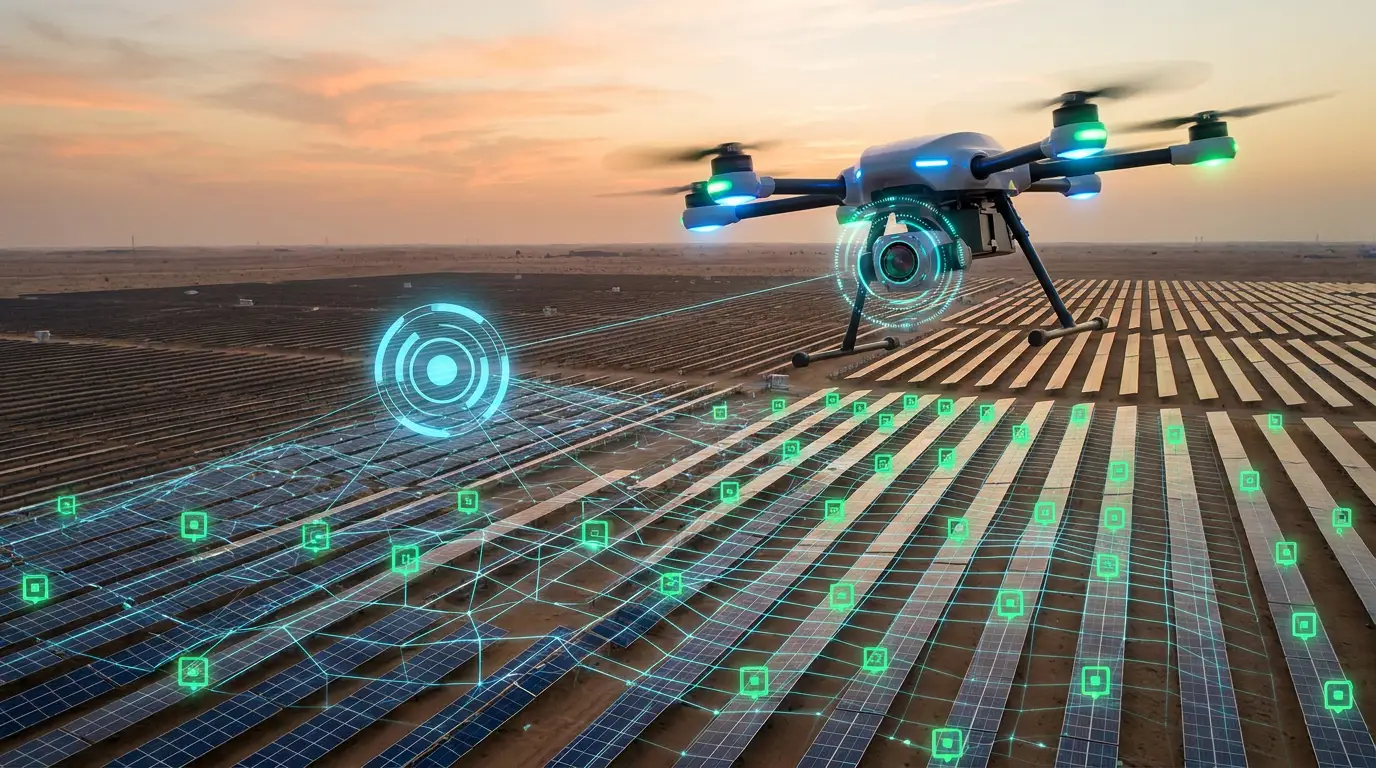
Automated Solar Panel Counting and Mapping with Drone AI
The Indian government has set ambitious targets for renewable energy, with solar power playing a significant role in the country's energy mix. As the number of solar panels installed across India continues to grow, the need for efficient and accurate monitoring and maintenance of these assets has become increasingly important. Automated solar panel counting and mapping with drone AI is an innovative solution that can help solar farm operators and owners streamline their operations, reduce costs, and improve overall efficiency. By leveraging high-resolution imagery captured by drones equipped with advanced sensors such as RGB, multispectral, or thermal cameras, AI algorithms can accurately count and map solar panels, detecting any issues or anomalies.
Looking for a provider? AiRotor Labs offers solar panel drone inspection services across India — thermal and RGB flights, AI defect classification and IEC 62446-3 reports, from ₹3,000 per MW.
Introduction to Drone-Based Solar Panel Inspection
Drone-based inspection of solar panels offers several advantages over traditional methods, including increased speed, reduced costs, and improved safety. Drones can capture high-resolution images of solar panels from various angles, allowing for a detailed analysis of their condition. The use of advanced sensors such as thermal cameras can help detect temperature anomalies, which can indicate potential issues with the panels. In India, the Directorate General of Civil Aviation (DGCA) has established rules and regulations for the operation of drones, including requirements for pilot training, drone registration, and airspace restrictions. AiRotor Labs, a leading drone services company in Ahmedabad, India, is well-versed in these regulations and has the expertise to conduct safe and efficient drone-based inspections.
Sensor Types and Accuracy
The type of sensor used on a drone plays a critical role in determining the accuracy of solar panel counting and mapping. RGB cameras can capture high-resolution images of the panels, while multispectral cameras can provide information on the reflectance and transmittance of light, helping to detect issues such as soiling or shading. Thermal cameras, on the other hand, can detect temperature anomalies, which can indicate potential hotspots or issues with the panels. The accuracy of automated solar panel counting and mapping with drone AI can vary depending on factors such as the resolution of the images, the type of sensor used, and the quality of the AI algorithm. However, typical accuracy numbers for drone-based solar panel inspection can range from 95% to 99%, depending on the specific use case and the quality of the data.
Typical Timelines and Workflows
The typical timeline for automated solar panel counting and mapping with drone AI can vary depending on the size of the solar farm and the complexity of the inspection. However, a typical workflow may involve the following steps: planning and preparation, drone deployment, data capture, data processing, and reporting. The planning and preparation phase can take several days to weeks, depending on the size of the solar farm and the complexity of the inspection. The drone deployment phase can take several hours to days, depending on the size of the area to be inspected. The data processing phase can take several days to weeks, depending on the amount of data captured and the complexity of the analysis. Overall, the entire process can take anywhere from a few weeks to several months, depending on the specific requirements of the project.
Benefits and Cost Savings
The benefits of automated solar panel counting and mapping with drone AI are numerous. By streamlining the inspection process, solar farm operators and owners can reduce costs, improve efficiency, and enhance overall productivity. The use of drone-based inspection can also help reduce the risk of accidents and injuries associated with traditional inspection methods. In addition, the high-resolution images captured by drones can provide valuable insights into the condition of the solar panels, helping to identify potential issues before they become major problems. While the exact cost savings of automated solar panel counting and mapping with drone AI can vary depending on the specific use case and the size of the solar farm, industry-typical ranges suggest that drone-based inspection can reduce costs by up to 50% compared to traditional methods.
Regulatory Considerations and Best Practices
In India, the DGCA has established rules and regulations for the operation of drones, including requirements for pilot training, drone registration, and airspace restrictions. Solar farm operators and owners must ensure that they comply with these regulations when using drones for inspection and mapping purposes. Best practices for automated solar panel counting and mapping with drone AI include ensuring that the drone is equipped with the necessary sensors and software, following established workflows and protocols, and maintaining accurate records of the inspection and mapping process. By following these best practices and complying with regulatory requirements, solar farm operators and owners can ensure that their drone-based inspection and mapping operations are safe, efficient, and effective.
Conclusion and Next Steps
Automated solar panel counting and mapping with drone AI is a powerful tool for solar farm operators and owners in India, offering improved efficiency, accuracy, and cost savings. By leveraging high-resolution imagery and advanced AI algorithms, solar farm operators and owners can streamline their operations, reduce costs, and improve overall productivity. If you are interested in learning more about how AiRotor Labs can help you with automated solar panel counting and mapping, please visit our website at https://www.airotor.in/booking to book a consultation with our experts. Our team has extensive experience in drone-based inspection and mapping, and we can help you navigate the regulatory requirements and best practices for drone-based solar panel inspection in India. Contact us today to learn more about how we can help you optimize your solar farm operations with automated solar panel counting and mapping with drone AI.
AiRotor Labs provides drone-based inspection, aerial survey, and land survey across India.
Book a consultation →