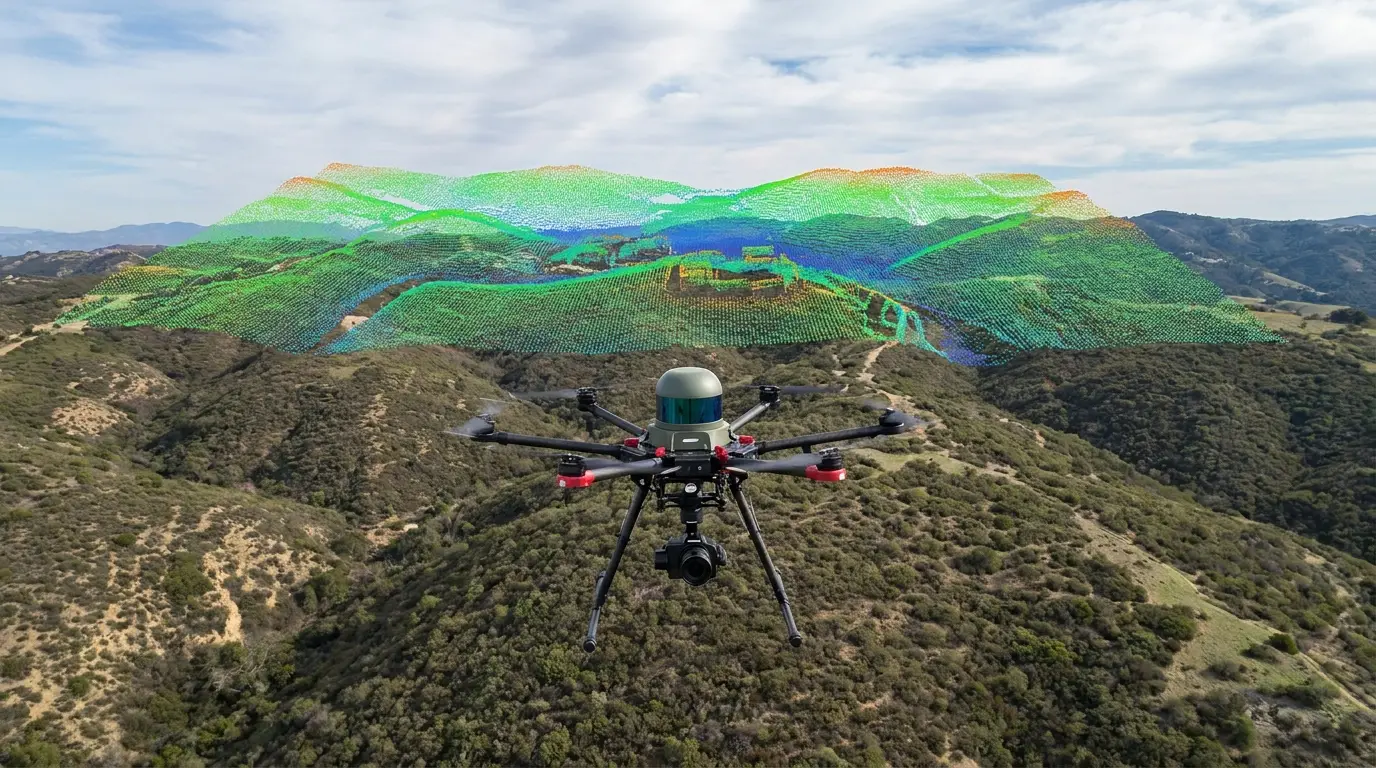
LiDAR vs Photogrammetry Drones: Choosing for Your Land Survey in India
Drone technology has revolutionised land surveying, offering unprecedented speed, accuracy, and cost-efficiency compared to traditional methods. For engineers, developers, urban planners, and project managers across India, the ability to rapidly capture vast amounts of spatial data has become indispensable. However, when it comes to selecting the right drone-based approach for land survey, a critical decision often arises: should you opt for LiDAR or photogrammetry? Both technologies leverage drones to create detailed 3D models and maps, but their underlying principles, strengths, and ideal applications differ significantly. Understanding these distinctions is key to making an informed choice that aligns with your project's specific requirements, budget, and the unique challenges of the Indian landscape. This guide will help you navigate the nuances of LiDAR vs photogrammetry drones to determine the best fit for your next land survey project.
Looking for a provider? AiRotor Labs offers drone land survey and mapping services across India — photogrammetry and LiDAR with RTK/PPK accuracy, from ₹800 per acre.
Understanding the Fundamentals: Photogrammetry Drones
Photogrammetry, in the context of drone surveying, involves capturing a series of overlapping georeferenced images of an area using a high-resolution RGB camera mounted on a drone. These images are then processed using specialised software (e.g., Pix4D, Agisoft Metashape) to create dense 3D point clouds, orthomosaic maps, digital surface models (DSMs), and digital terrain models (DTMs).
How it works: The software uses "Structure-from-Motion" (SfM) algorithms to identify common points across multiple images, triangulate their positions in 3D space, and reconstruct the scene. The quality of the output heavily relies on image overlap, lighting conditions, and the presence of distinct features (texture) in the terrain.
Typical Sensors: Common photogrammetry drones utilise high-resolution full-frame or medium-format RGB cameras, such as the DJI Zenmuse P1, Sony a6000 series, or various custom-integrated setups. These cameras excel at capturing rich visual detail.
Outputs:
- Orthomosaic Maps: Geometrically corrected aerial images, free of distortion, showing true ground distances.
- Digital Surface Models (DSMs): Represent the elevation of the earth's surface including all features on it (buildings, trees, etc.).
- Digital Terrain Models (DTMs): Represent the bare earth elevation, with all above-ground features digitally removed. This is where photogrammetry can face challenges.
- 3D Point Clouds: A collection of millions of data points, each with X, Y, Z coordinates and RGB colour values, representing the surveyed area.
Accuracy: With proper ground control points (GCPs) and RTK/PPK enabled drones, photogrammetry can achieve horizontal accuracies of 1-5 cm and vertical accuracies of 2-10 cm.
Pros:
- Cost-Effective: Generally, photogrammetry drone hardware and software are less expensive than LiDAR systems.
- High-Resolution Imagery: Provides visually rich orthomosaics, crucial for visual inspections and detailed mapping.
- Ease of Use: Workflows are often more straightforward, making it accessible for a broader range of projects.
- Versatile Deliverables: Excellent for volume calculations, general topographic maps, construction progress monitoring, and asset management.
Cons:
- Vegetation Penetration: Struggles to 'see' through dense foliage. DTMs generated under heavy tree cover can be inaccurate as the camera captures the tree canopy, not the ground below. This is a significant limitation in India's diverse and often vegetated landscapes.
- Lighting Dependent: Performance can be affected by poor lighting, shadows, or uniform surfaces lacking texture.
- Processing Intensive: Requires significant computational power for large datasets.
Applications in India: Ideal for open-pit mining, agricultural land mapping, urban planning in developed areas, construction site monitoring, and general topographic mapping where dense vegetation isn't a major concern.
Understanding the Fundamentals: LiDAR Drones
LiDAR (Light Detection and Ranging) technology uses pulsed laser beams to directly measure distances to the ground and other features. A LiDAR sensor emits millions of laser pulses per second, and by measuring the time it takes for each pulse to return, it calculates the precise 3D coordinates of points on the surface.
How it works: Unlike photogrammetry, which infers 3D structure from 2D images, LiDAR directly captures 3D points. Crucially, many laser pulses can penetrate gaps in vegetation, allowing the sensor to record points on the bare earth beneath the canopy. This ability to "see through" foliage is a game-changer for accurate bare-earth mapping.
Typical Sensors: LiDAR drones integrate sophisticated laser scanners like the DJI Zenmuse L1, Velodyne PUCK, Livox Avia, or more advanced RIEGL systems. These sensors are designed for precise distance measurement and rapid data acquisition.
Outputs:
- Dense Point Clouds: The primary output is a highly accurate 3D point cloud, often millions or even billions of points, each with X, Y, Z coordinates, intensity values (reflectivity), and sometimes RGB colour if a camera is integrated.
- Bare-Earth Digital Terrain Models (DTMs): LiDAR excels at generating highly accurate DTMs by filtering out points from vegetation and structures.
- Contour Maps: Precise contour lines derived directly from the DTM.
Accuracy: LiDAR systems, especially those with RTK/PPK integration, can achieve superior vertical accuracies, often in the range of 1-5 cm, and horizontal accuracies of 1-3 cm, even in challenging environments.
Pros:
- Superior Vegetation Penetration: This is LiDAR's most significant advantage. It can generate highly accurate bare-earth DTMs even under dense forest canopy, which is invaluable for infrastructure projects in forested or hilly regions of India.
- Direct 3D Measurement: Provides direct and highly accurate 3D coordinates, reducing reliance on indirect methods.
- Works in Challenging Conditions: Less affected by poor lighting, shadows, or uniform surfaces. Can operate effectively day or night.
- High Vertical Accuracy: Often surpasses photogrammetry for vertical accuracy, critical for engineering design, flood plain mapping, and precise volume calculations.
Cons:
- Higher Cost: LiDAR drone systems, including sensors and processing software, are significantly more expensive than photogrammetry setups.
- Larger Data Files: LiDAR point clouds are typically much larger than photogrammetry datasets, requiring more storage and processing power.
- No Direct Imagery: While some LiDAR sensors integrate RGB cameras for colourising point clouds, the primary output is not a traditional photographic image.
- Complex Processing: Processing LiDAR data, especially filtering for bare earth, requires specialised expertise.
Applications in India: Critical for transmission line corridor mapping, detailed flood plain analysis, precise infrastructure development (roads, railways, pipelines) through vegetated terrain, forestry management, and geological surveys.
Key Differentiators for Land Survey in India
When deciding between LiDAR vs photogrammetry drones for your land survey project in India, consider these critical differentiators:
Vegetation Cover: India's diverse geography includes vast tracts of forests, dense agricultural fields, and urban areas with significant tree cover. If your project area has moderate to dense vegetation and an accurate bare-earth DTM is essential (e.g., for calculating earthworks volumes, designing drainage, or flood modelling), LiDAR is the undisputed winner. Photogrammetry will capture the canopy, leading to significant inaccuracies in the ground model.
Accuracy Requirements: For projects demanding the highest possible vertical accuracy, such as precision engineering, infrastructure design, or detailed hydrological modelling, LiDAR's direct 3D measurement and superior bare-earth DTM capabilities often make it the preferred choice. For general topographic mapping or visual documentation where relative accuracy is sufficient, photogrammetry can be adequate.
Terrain and Environmental Conditions:
- Hilly/Mountainous Terrain: Both can work, but LiDAR's ability to penetrate vegetation becomes crucial in forested hills.
- Urban Areas: Both can generate excellent models. Photogrammetry provides rich visual context, while LiDAR can precisely map building facades and complex structures.
- Monsoon Season/Cloud Cover: Photogrammetry requires clear skies and good light. LiDAR is less affected by low light or haze, offering more operational flexibility in India's variable weather.
Budget and Project Scale: Photogrammetry is generally more budget-friendly for smaller projects or those where visual data is paramount and vegetation is sparse. For large-scale infrastructure projects, complex terrains, or where the cost of inaccuracy is high, the initial investment in LiDAR pays dividends in data quality and project efficiency.
Deliverables Needed: Do you primarily need high-resolution orthomosaic maps for visual assessment, or is a highly accurate bare-earth DTM for engineering design the priority? Your required output will strongly influence your choice.
DGCA Regulations and Drone Operations in India
Regardless of whether you choose LiDAR or photogrammetry drones, all drone operations in India are governed by the Directorate General of Civil Aviation (DGCA) Drone Rules, 2021. AiRotor Labs strictly adheres to these regulations to ensure legal, safe, and efficient operations. Key aspects include:
- Remote Pilot Certificate: All drone pilots must hold a valid Remote Pilot Certificate issued by a DGCA-authorised Remote Piloting Training Organisation (RPTO).
- Drone Registration: Drones used for commercial purposes must be registered and possess a unique identification number (UAIN).
- Flight Permissions: Operations in 'Yellow Zones' require permission from the Air Traffic Control (ATC) authority, while 'Red Zones' are no-fly areas. Operations in 'Green Zones' typically require only intimation through the DigitalSky platform.
- Drone Categories: Survey drones typically fall under 'Small' or 'Medium' categories, requiring specific operating procedures and compliance.
Understanding and complying with these rules is paramount for any drone-based land survey project in India. AiRotor Labs manages all necessary permissions and ensures fully compliant operations.
When to Choose Which for Your Land Survey Project
Making the right choice between LiDAR vs photogrammetry drones boils down to aligning the technology with your project's unique demands.
Choose Photogrammetry if:
- Budget is a primary constraint.
- The project area has minimal to no dense vegetation, or you need to map features above the ground (e.g., building rooftops, tree canopies).
- **High-resolution visual imagery (orthomosaics) is as
AiRotor Labs provides drone-based inspection, aerial survey, and land survey across India.
Book a consultation →