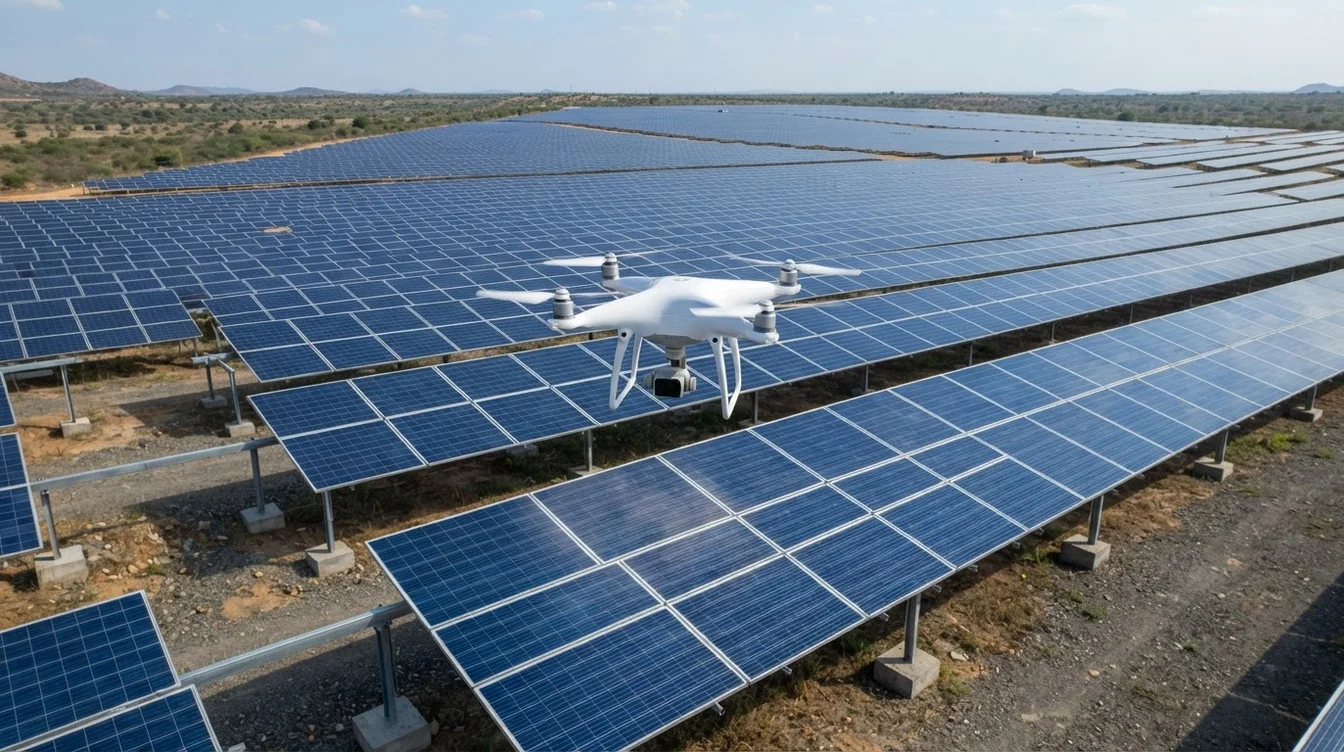
Solar Panel RFID Scanning Using Drones for Asset Tracking and Audits
Utility-scale solar farms in India routinely carry 100,000 to over a million individual panels, each one a serialized asset with a manufacturer warranty, a commissioning date, and a position in the plant's asset register. Keeping that register accurate has traditionally meant technicians walking rows with handheld RFID scanners or barcode guns — a slow, error-prone job on a site that can span several hundred acres. Drone-based RFID scanning replaces that walk with a flight: a drone carrying a UHF RFID reader and antenna passes over the panel rows and captures tag reads automatically, matching each panel's unique ID to its GPS location in a fraction of the time.
How RFID Tagging Works on Solar Panels
Most utility-scale panels shipped in the last few years carry a passive UHF RFID tag, usually laminated into the junction box or backsheet during manufacturing, encoded with a unique EPC (Electronic Product Code) that ties back to the panel's serial number, batch, and factory test data. These tags operate in the 860–960 MHz band under the ISO 18000-6C (EPC Gen2) standard, the same protocol used in retail and logistics tracking, and require no battery — they draw power from the reader's radio signal to respond. Because the tag is fixed at the time of manufacture, it survives the panel's full 25-year field life better than a printed barcode, which fades and gets covered in dust.
How Drone-Based RFID Scanning Works
A drone RFID setup pairs a small UHF reader module (such as a Zebra or Impinj-based reader) with a circularly polarized panel antenna mounted on the drone's underside, connected to a companion computer that timestamps and geotags every tag read against the drone's RTK GPS position. The drone flies a lawnmower survey pattern over the panel table rows at a set altitude and speed, and the reader continuously interrogates tags in its beam. Read range depends on antenna gain, tag orientation, and interference from the metal panel frames, but with a well-tuned setup drones typically read tags reliably from 3–6 metres, which lets the aircraft fly high enough to clear obstacles while still covering multiple rows per pass. Flight altitude and forward speed have to be tuned together — too fast, and the dwell time over a tag isn't enough for a reliable read; too slow, and the survey takes longer than a walking audit would.
Accuracy, Read Rates, and Common Failure Points
Read rates on a well-planned flight are generally in the 90–98% range on the first pass, with a second overlapping pass used to pick up any tags missed due to shadowing from adjacent panel frames or mounting structure. Metal racking is the single biggest source of missed reads, since it reflects and detunes UHF signals, so flight planning usually accounts for row spacing and mounting angle rather than assuming a uniform read range across the site. Any tags that still don't register after two passes get flagged for manual verification — a small fraction of the total, but one that matters when the output feeds a warranty claim or an insurance audit. Data is post-processed to de-duplicate repeat reads and cross-reference each EPC against the plant's commissioning records, producing a reconciled asset list rather than a raw read log.
Typical Timelines and DGCA Compliance
For a 50 MW plant with roughly 100,000–120,000 panels, a full RFID audit typically takes one to two days of flight time split across multiple battery cycles, followed by two to three days of data reconciliation and reporting — considerably faster than the one to two weeks a manual handheld audit of the same site would take. Because this is still a drone operation over an operational power asset, it falls under DGCA rules: the operator needs a valid Unique Identification Number (UIN) or Unique Authorisation Number (UAN) as applicable, must fly within visual line of sight unless a separate BVLOS approval is in place, and should coordinate with the plant operator on any restricted or notified airspace near the site. AiRotor Labs plans every RFID survey around these requirements alongside the plant's existing safety protocols for working near live electrical infrastructure.
Why Operators Are Adopting Drone RFID Audits
The core driver is reconciliation speed. Asset registers drift over time — panels get swapped during O&M, warranty claims replace defective units, and paperwork doesn't always keep pace with what's physically installed. A drone RFID pass gives an operator a ground-truth snapshot of exactly which serialized panel sits at which GPS coordinate, which is valuable for three recurring situations: annual insurance and lender audits that require a verified asset count, warranty claims where the manufacturer needs proof of the specific serial number and installation date, and theft or tampering investigations, since a missing tag read at a known location is an immediate red flag. It also removes a meaningful amount of manual labour and site-access risk — technicians no longer need to walk live rows with handheld scanners for a routine count.
Getting Started with a Drone RFID Audit
A drone RFID scan works best as a complement to, not a replacement for, existing thermal and visual drone inspections — the same flight infrastructure and DGCA approvals can often support both missions on the same site visit, which is where the real cost efficiency comes in. Before commissioning a survey, it's worth confirming with your panel manufacturer whether your installed panels are RFID-tagged (most Tier-1 manufacturers have shipped tagged panels since around 2020) and requesting the EPC-to-serial-number mapping file needed for reconciliation.
If your solar plant has RFID-tagged panels and you need an accurate, audit-ready asset register, AiRotor Labs can plan and execute a drone-based RFID scanning survey alongside your regular inspection schedule. Visit https://www.airotor.in/booking to book a consultation and get a reconciled asset count without pulling your O&M team off the roof.
AiRotor Labs provides drone-based inspection, aerial survey, and land survey across India.
Book a consultation →