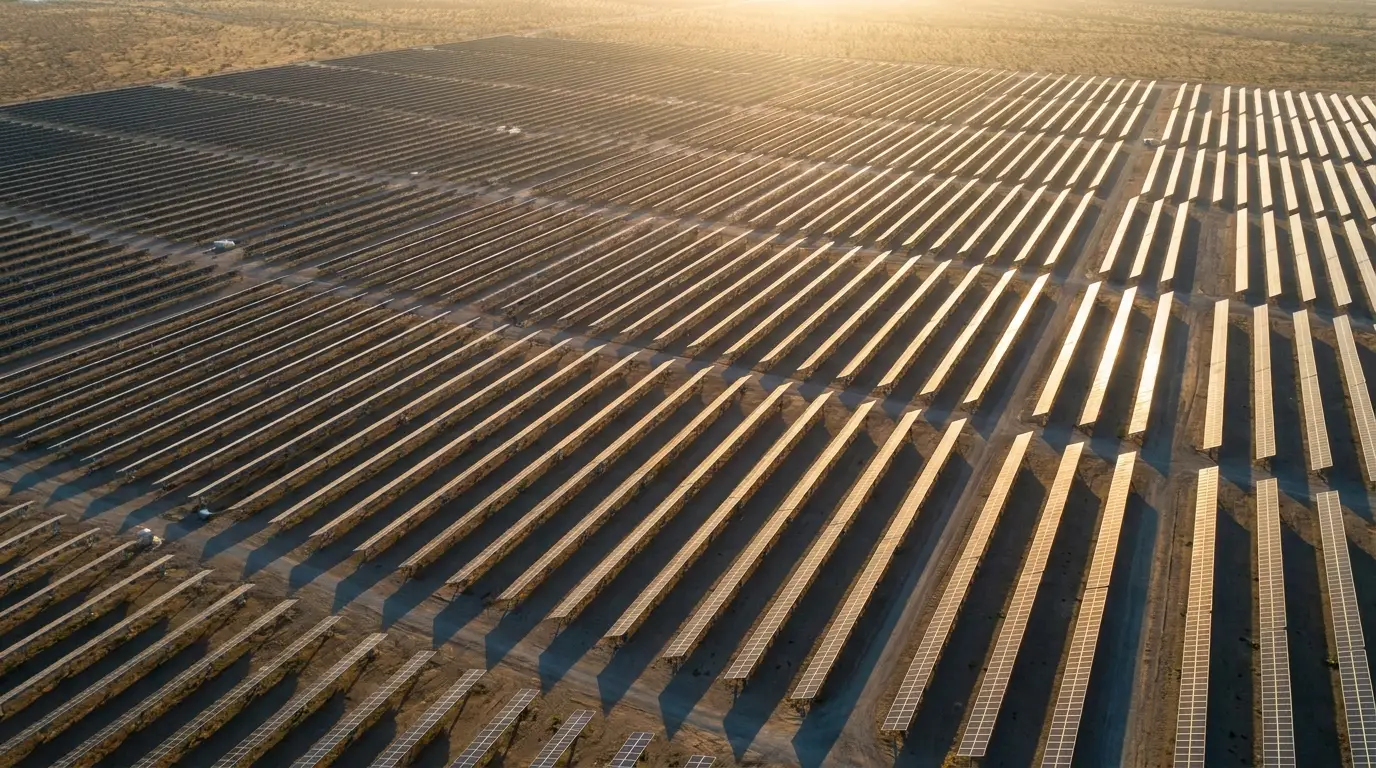
Precision Solar Tracker Alignment Verification with Aerial Drone Imagery
India's renewable energy landscape is rapidly expanding, with solar power leading the charge. Utility-scale solar farms, especially those employing advanced single-axis or dual-axis solar trackers, are becoming increasingly common. These trackers are designed to maximize energy capture by continuously orienting solar panels towards the sun throughout the day. However, the performance of these sophisticated systems hinges entirely on their precise mechanical and software alignment. Even minor deviations can lead to significant energy losses and increased operational stresses.
Looking for a provider? AiRotor Labs offers solar panel drone inspection services across India — thermal and RGB flights, AI defect classification and IEC 62446-3 reports, from ₹3,000 per MW.
Traditionally, verifying the alignment of thousands of trackers across vast solar farms has been a laborious, time-consuming, and often hazardous manual process. But what if there was a faster, safer, and infinitely more accurate way to ensure every single tracker is performing optimally? This is where solar tracker alignment verification with aerial drone imagery emerges as a game-changer, offering unparalleled precision and efficiency for solar asset owners and operators.
The Critical Role of Solar Tracker Alignment in Energy Yield
Solar trackers are engineered to follow the sun's path with high accuracy, typically within a degree or two. This constant adjustment can increase energy yield by 10-25% compared to fixed-tilt systems. However, this advantage is quickly eroded if trackers fall out of alignment.
Misalignment can stem from various issues:
- Foundation settlement: Over time, ground movement can cause tracker foundations to shift.
- Mechanical wear and tear: Motors, gears, and bearings can degrade, leading to imprecise movement.
- Software calibration errors: Incorrect settings can send trackers to the wrong angles.
- Physical damage: Impact from weather events or machinery can bend structures.
Even a small angular deviation, say 2-3 degrees, across hundreds or thousands of trackers can translate into substantial energy losses annually. This directly impacts revenue, extends payback periods, and can lead to premature wear on tracker components as motors overcompensate or panels experience uneven stress. Identifying these subtle misalignments quickly and accurately is paramount for maintaining peak plant performance and extending asset lifespan.
How Drones Revolutionize Alignment Verification
Enter the power of drone technology. Instead of relying on manual spot checks or time-consuming ground-based surveys, drones equipped with high-resolution cameras can rapidly capture comprehensive data across an entire solar farm. This aerial perspective allows for a holistic assessment that is simply not feasible with traditional methods.
The core principle behind drone-based solar tracker alignment verification involves creating highly accurate 2D orthomosaic maps and 3D models of the solar farm. By precisely geo-referencing every solar panel and tracker structure, we can then perform sophisticated spatial analysis to determine the exact orientation and tilt of each individual tracker. This data provides an objective, quantifiable measure of alignment for every single array.
The Technology Behind Accurate Verification
Achieving centimeter-level accuracy for solar tracker alignment verification demands cutting-edge drone hardware, advanced sensors, and sophisticated software.
Industrial-Grade Drones: AiRotor Labs utilizes professional-grade Unmanned Aerial Vehicles (UAVs) like the DJI Matrice series, known for their stability, reliability, and payload capacity. These platforms can withstand diverse weather conditions and carry the necessary high-precision sensors.
High-Resolution RGB Cameras with RTK/PPK GNSS: The primary sensor for alignment verification is a high-resolution RGB camera (e.g., 40-60+ megapixels). Crucially, these cameras are integrated with Real-Time Kinematic (RTK) or Post-Processed Kinematic (PPK) Global Navigation Satellite System (GNSS) modules.
- RTK/PPK technology corrects GPS errors in real-time or post-flight using ground reference stations or base stations. This enables the drone to record the precise coordinates of each image capture point with an accuracy of 1-3 centimeters horizontally and vertically. This level of geo-spatial accuracy is fundamental for deriving precise angular measurements of tracker orientation.
- While thermal cameras are excellent for detecting module-level defects like hot spots, for purely mechanical alignment verification, high-resolution RGB imagery combined with RTK/PPK is the gold standard.
Advanced Photogrammetry and Analysis Software: The raw drone imagery is processed using specialized photogrammetry software (e.g., Pix4Dmapper, Agisoft Metashape, Bentley ContextCapture). This software stitches thousands of overlapping images into a seamless, geo-referenced orthomosaic map and generates a detailed 3D point cloud or mesh model of the site.
- From these precise models, specialized algorithms can then extract the orientation (azimuth) and tilt (elevation) of each tracker row. By comparing these measured angles against the design specifications or the ideal sun-tracking path for that specific time and location, deviations can be quantified down to fractions of a degree.
The Process: From Flight to Insight
The process of drone-based solar tracker alignment verification is systematic and efficient:
Pre-flight Planning and DGCA Compliance: Our certified drone pilots meticulously plan the flight mission using specialized software. This involves defining flight paths, altitude, speed, and image overlap (typically 70-80% front and side overlap) to ensure comprehensive data capture and optimal Ground Sample Distance (GSD) – often 1-2 cm per pixel for high-accuracy applications. All operations strictly adhere to the Directorate General of Civil Aviation (DGCA) UAS Rules 2021/2024, including obtaining necessary flight permissions through the Digital Sky platform and operating with registered drones and licensed pilots.
Automated Data Acquisition: The drone executes the pre-programmed flight path autonomously, capturing thousands of high-resolution, geo-tagged images across the entire solar farm. A typical 100-acre solar farm can be surveyed in just a few hours, a fraction of the time required for manual methods.
Data Processing and Model Generation: The collected imagery is then uploaded to powerful workstations for processing. The photogrammetry software aligns the images, triangulates tie points, and generates a highly accurate, geo-referenced orthomosaic map, 3D point cloud, and/or 3D mesh model of the entire site.
Alignment Analysis and Reporting: Our expert analysts use the 3D data to precisely measure the azimuth and tilt angles of each tracker. This data is then compared against the design parameters or the optimal sun position. Deviations are identified, quantified, and categorized. A comprehensive report is generated, highlighting:
- An interactive map showing the location of every tracker.
- Color-coded visualizations indicating areas of misalignment.
- A detailed table listing the measured deviation for each tracker.
- Recommendations for corrective actions, prioritized by severity.
Benefits for Indian Solar Farms & DGCA Compliance
Adopting drone-based solutions for solar tracker alignment verification offers compelling advantages for solar asset owners and operators across India:
- Significant Energy Yield Increase: By identifying and correcting misalignments, solar farms can recover lost energy production, directly boosting revenue and improving ROI. The cumulative effect across thousands of trackers is substantial.
- Reduced O&M Costs and Enhanced Safety: Proactive identification of issues prevents minor misalignments from escalating into major mechanical failures, reducing costly repairs and downtime. Drone inspections eliminate the need for personnel to navigate hazardous terrain or work at heights, significantly improving safety.
- Unparalleled Accuracy and Consistency: Drones provide objective, data-driven insights that are consistent and repeatable, eliminating human error inherent in manual inspections. The precision offered by RTK/PPK GNSS-enabled drones ensures that even subtle deviations are detected.
- Scalability for Large Projects: India's utility-scale solar projects often span hundreds or even thousands of acres. Drones can efficiently cover these vast areas, making comprehensive alignment verification feasible and cost-effective for even the largest installations.
- Data-Driven Decision Making: The detailed reports provide actionable intelligence, allowing maintenance teams to prioritize repairs, allocate resources effectively, and track the effectiveness of corrective measures over time.
- Ensuring Regulatory Compliance: AiRotor Labs operates in full compliance with DGCA regulations, ensuring that all drone services are conducted legally and safely. This provides peace of mind for solar farm operators, knowing their inspections adhere to national aviation standards.
For India's growing solar sector, embracing advanced inspection techniques like drone-based solar tracker alignment verification is not just an option, but a strategic imperative for maximizing efficiency, profitability, and sustainability.
Ensure your solar farm is performing at its absolute peak. Don't let misaligned trackers drain your energy yield. AiRotor Labs offers cutting-edge drone inspection services across Ahmedabad and India, providing precise, actionable insights for your solar assets.
Ready to optimize your solar farm's performance? Contact AiRotor Labs today for a consultation or to book your next drone inspection. Visit us at https://www.airotor.in/booking and let's power your success.
AiRotor Labs provides drone-based inspection, aerial survey, and land survey across India.
Book a consultation →