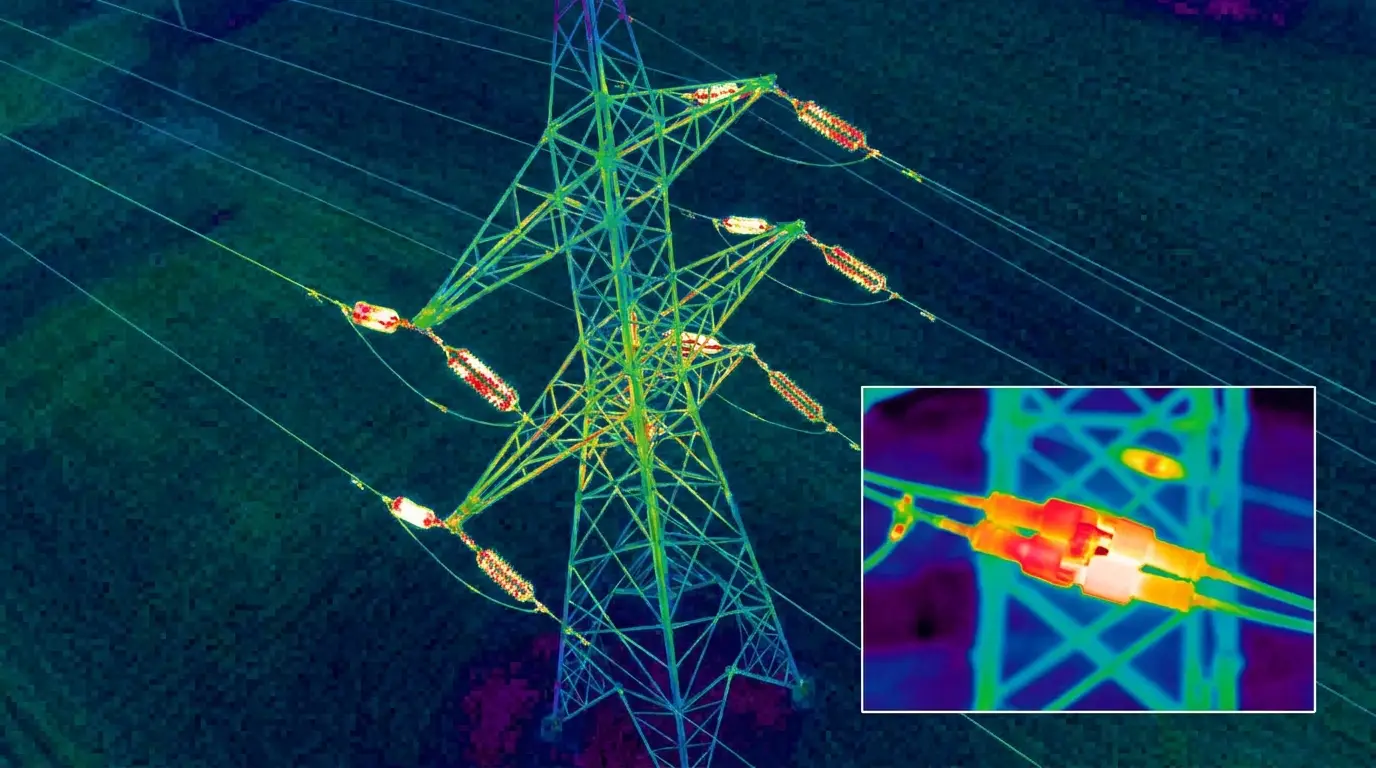
Thermal Imaging of Electrical Joints & Splices on Transmission Towers
India's economic growth is inextricably linked to a robust and reliable power infrastructure. At the heart of this infrastructure are thousands of kilometres of transmission lines, tirelessly delivering electricity across diverse terrains, from bustling cities to remote rural areas. Maintaining these vast networks is a monumental task, where even a minor fault can cascade into widespread outages, significant economic losses, and safety hazards. Traditionally, inspections have been manual, time-consuming, and fraught with risks. However, advancements in drone technology, particularly in thermal imaging, are revolutionising how we approach the integrity of these critical assets.
Looking for a provider? AiRotor Labs offers transmission line drone inspection services across India — thermal, LiDAR and corona inspection of live lines, ₹5,000–₹15,000 per km.
At AiRotor Labs, based in Ahmedabad, we understand the unique challenges faced by India's power sector. Our drone-based solutions offer an unparalleled advantage in identifying potential failures long before they escalate. This post dives deep into a crucial application: thermal imaging of electrical joints and splices on transmission towers, a proactive measure that is becoming indispensable for ensuring grid reliability and operational safety.
Why Electrical Joints and Splices are Critical Failure Points
Transmission lines are not continuous conductors; they are segmented and connected using a variety of joints, splices, and connectors. These components are essential for extending line lengths, connecting different sections, and attaching to equipment like insulators and transformers. While designed for durability, these points are inherently more vulnerable to degradation than the main conductor body.
Several factors contribute to the vulnerability of electrical joints and splices:
- Thermal Expansion and Contraction: Daily and seasonal temperature fluctuations cause conductors and connectors to expand and contract. Over time, this constant movement can loosen connections, reduce contact pressure, and lead to micro-fractures.
- Vibration and Mechanical Stress: Wind, conductor galloping, and external impacts subject these points to significant mechanical stress, accelerating wear and tear.
- Corrosion: Exposure to environmental elements like moisture, dust, pollutants, and salt spray (especially in coastal regions like Gujarat) can lead to oxidation and corrosion at contact surfaces, increasing electrical resistance.
- Improper Installation: Poor crimping, insufficient torque, or inadequate surface preparation during installation can create initial high-resistance points, which worsen over time.
- Fatigue: Continuous electrical and mechanical stresses can lead to material fatigue, weakening the structural and electrical integrity of the joint.
When any of these factors compromise a joint or splice, its electrical resistance increases. According to Joule's Law, increased resistance leads to increased heat generation (P = I²R). This localised overheating, or "hot spot," is a tell-tale sign of an impending failure. Without early detection, these hot spots can lead to conductor annealing, insulation breakdown, arcing, flashovers, and ultimately, catastrophic failures that disrupt power supply and pose severe safety risks.
The Science Behind Thermal Imaging for Predictive Maintenance
Thermal imaging, or infrared thermography, is a non-contact, non-destructive diagnostic technique that detects infrared (IR) energy emitted by objects and converts it into a visual image. All objects above absolute zero (-273.15°C) emit IR radiation, and the intensity of this radiation increases with temperature.
For electrical components like joints and splices, the principle is straightforward: a healthy connection has low electrical resistance and operates at or near the ambient temperature of the conductor. A faulty connection, due to increased resistance, generates excess heat, making it hotter than its surroundings. Thermal cameras are designed to "see" this invisible heat radiation.
Modern drone-integrated thermal cameras, often utilising uncooled microbolometer sensors (e.g., FLIR's Tau2 or Boson series), can provide highly accurate temperature measurements. Common resolutions for these sensors range from 336x256 to 640x512 pixels, offering sufficient detail for inspecting transmission line components from a safe distance. Crucially, these are radiometric cameras, meaning each pixel in the thermal image can measure and record a precise temperature value. This allows for quantitative analysis, not just qualitative observation.
The accuracy of these sensors is typically within ±2°C or ±2% of the reading (whichever is greater), which is critical for identifying subtle temperature anomalies that indicate early-stage issues. By precisely measuring temperature differences (Delta-T) between a suspect component and healthy adjacent sections, maintenance teams can accurately diagnose the severity of a fault. For instance, a temperature differential of 10-20°C above ambient or adjacent components might indicate a minor issue, while a differential exceeding 40°C could signify a critical problem requiring immediate attention.
Drone-Based Thermal Inspections: Advantages for Transmission Towers in India
Deploying drones for thermal imaging of electrical joints and splices on transmission towers offers a multitude of benefits, particularly suited to the operational landscape of India:
- Enhanced Safety: Manual inspections often require skilled personnel to climb towering structures, working at significant heights and in close proximity to high-voltage lines. This is inherently dangerous. Drones eliminate this risk, keeping human operators safely on the ground, away from live conductors and fall hazards.
- Unmatched Efficiency and Speed: A single drone can inspect kilometres of transmission lines in a fraction of the time it would take a ground crew. This drastically reduces the time required for inspections, minimising power grid downtime for planned outages (if any are needed for specific checks) and accelerating the identification of critical issues across vast networks.
- Superior Accessibility: India's diverse geography includes challenging terrains like mountainous regions, dense forests, and remote rural areas where transmission lines often traverse. Drones can easily access these difficult-to-reach locations, providing a comprehensive inspection coverage that would be impractical or impossible for ground crews.
- High-Quality, Actionable Data: Drones equipped with high-resolution thermal and visual (RGB) cameras capture detailed imagery and radiometric data. This data is GPS-tagged, allowing for precise location identification of anomalies. The combination of visual evidence and accurate temperature readings provides maintenance teams with clear, actionable insights for prioritising repairs.
- Cost-Effectiveness: While there's an initial investment in drone services, the long-term cost savings are substantial. Reduced labour costs, fewer equipment failures, prevented outages, and optimised maintenance schedules lead to significant operational efficiencies and financial benefits.
- Regulatory Compliance (DGCA): Operating drones in India requires strict adherence to the Directorate General of Civil Aviation (DGCA) Civil Aviation Requirements (CARs). Reputable drone service providers like AiRotor Labs ensure all operations are compliant. This includes using DGCA-registered drones, employing DGCA-certified remote pilot licence holders, obtaining necessary flight permissions through the DigitalSky platform (especially for flying in yellow or red zones), and adhering to specific operational guidelines. This commitment to regulatory compliance ensures safe, legal, and professional drone operations, adding a layer of trust and reliability to the inspection process.
What to Expect During a Thermal Inspection for Transmission Lines
A professional drone-based thermal inspection for transmission lines involves several key stages to ensure comprehensive and accurate data collection:
- Pre-Flight Planning and Permissions:
- Route Mapping: Detailed flight paths are planned based on the transmission line corridors, considering terrain, obstacles, and optimal vantage points for thermal data capture.
- Weather Assessment: Ideal conditions are crucial. Low wind speeds ensure stable flight and clear imagery, while overcast skies can minimise solar reflection on components, which can sometimes interfere
AiRotor Labs provides drone-based inspection, aerial survey, and land survey across India.
Book a consultation →