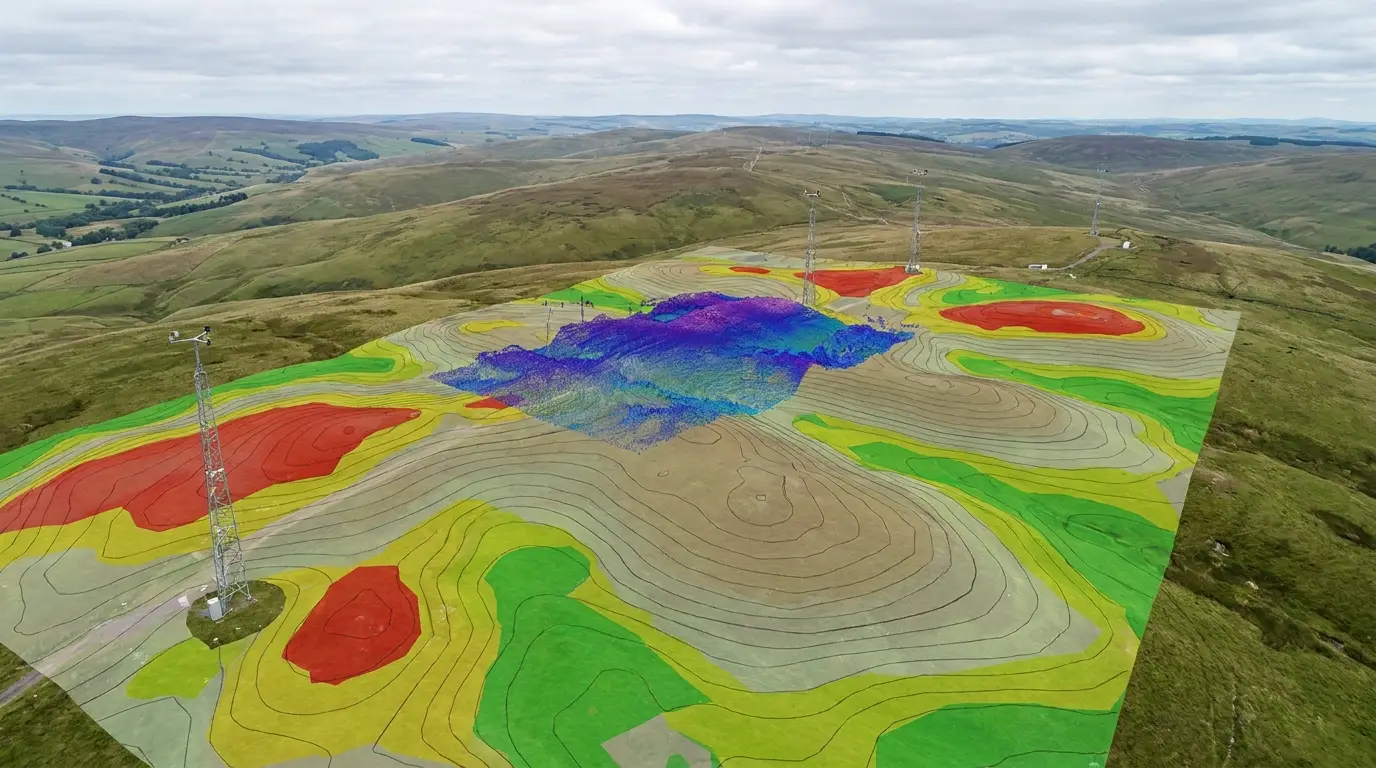
Optimizing Wind Farm Development: The Power of Drone LiDAR for Site Survey and Micro-Siting
India's commitment to renewable energy is unwavering, with wind power playing a pivotal role in our ambitious targets. Developing a successful wind farm, however, is a complex undertaking. It demands meticulous planning, precise data, and an intimate understanding of the chosen terrain. Historically, this process has been time-consuming, costly, and often fraught with inaccuracies stemming from traditional survey methods.
Looking for a provider? AiRotor Labs offers wind turbine drone inspection services across India — blade, nacelle and tower inspection without rope access, ₹15,000–₹30,000 per turbine.
Enter drone LiDAR technology. This innovation is rapidly transforming how developers approach wind farm site survey and micro-siting with drone LiDAR, offering unparalleled efficiency, safety, and data fidelity. For a country like India, with its diverse and often challenging topography, this technology isn't just an advantage—it's a necessity for unlocking the full potential of our wind resources.
The Evolution of Wind Farm Site Selection: From Manual to Autonomous
Traditional wind farm site surveys relied heavily on manual ground surveys, often supplemented by satellite imagery and limited aerial photography. These methods presented several inherent limitations:
- Time-Consuming: Large areas require extensive man-hours, often stretching timelines for months.
- Safety Risks: Surveyors face hazards in rugged, remote, or heavily vegetated terrains.
- Data Gaps: Dense vegetation can obscure crucial ground features, leading to incomplete or inaccurate Digital Terrain Models (DTMs).
- Costly Logistics: Mobilizing large survey teams and equipment to remote locations incurs significant expenses.
- Limited Detail: Ground surveys provide point-specific data, making it difficult to capture the nuanced topography of vast areas comprehensively.
Drone LiDAR systems overcome these challenges by rapidly acquiring high-density point clouds from an aerial perspective. A LiDAR (Light Detection and Ranging) sensor mounted on a drone emits laser pulses, measuring the time it takes for these pulses to return after hitting a surface. By combining this data with precise GPS (GNSS) and Inertial Measurement Unit (IMU) information, a highly accurate 3D representation of the terrain is generated, even through dense canopy thanks to multi-return laser technology. This fundamental shift allows for faster decision-making, reduced project risks, and ultimately, a more profitable wind farm.
Why Drone LiDAR is Indispensable for Initial Wind Farm Site Surveys
The initial site survey is the bedrock of any wind farm project. It determines the suitability of a location, identifies potential challenges, and informs preliminary design. Drone LiDAR offers several critical advantages here:
- Unrivalled Data Accuracy and Density: Drone LiDAR can capture millions of data points per second, generating highly accurate Digital Elevation Models (DEMs), Digital Terrain Models (DTMs), and Digital Surface Models (DSMs). Typically, vertical accuracies of 5-10 cm and horizontal accuracies of 10-20 cm can be achieved, which is crucial for precise engineering. This level of detail is impossible to achieve with traditional methods over large areas.
- Vegetation Penetration: A key differentiator for LiDAR is its ability to "see through" vegetation. Multi-return LiDAR sensors can record multiple reflections from a single laser pulse, allowing for accurate mapping of the bare ground beneath dense foliage – a common challenge in many parts of India. This ensures a true DTM, vital for wind flow modeling.
- Enhanced Safety and Efficiency: Drones eliminate the need for human surveyors to access dangerous or inaccessible terrain, significantly improving safety. What might take weeks or months with traditional methods can often be completed in a matter of days with a drone LiDAR system, drastically accelerating project timelines.
- Comprehensive Obstacle Mapping: Beyond terrain, LiDAR data precisely maps all surface features, including existing infrastructure, buildings, power lines, and other potential obstructions that could influence wind flow or turbine placement.
For developers seeking to identify prime locations in India's diverse geographical landscape, from the arid plains of Rajasthan to the rugged coastlines of Gujarat, drone LiDAR provides the foundational data needed for informed strategic decisions.
Micro-siting with Precision: Optimizing Turbine Placement
Once a suitable site is identified, the next critical phase is micro-siting – the precise placement of individual wind turbines within the chosen area. This process is where the detailed data from a wind farm site survey and micro-siting with drone LiDAR truly shines, directly impacting the wind farm's energy yield and operational longevity.
- Accurate Terrain Modeling for Wind Flow Analysis: High-resolution DTMs derived from LiDAR are fed into advanced Computational Fluid Dynamics (CFD) models. These models simulate how wind interacts with the terrain, predicting wind speed, direction, and turbulence at various points across the site. Accurate terrain data is paramount for these simulations, as even subtle topographic features can significantly alter local wind patterns.
- Optimizing Turbine Spacing and Layout: LiDAR data helps identify optimal turbine locations that maximize energy capture while minimizing negative interactions like wake effects. Wake effects, where the wind flowing past an upstream turbine reduces the wind speed for downstream turbines, can significantly diminish overall farm efficiency. Precise micro-siting mitigates these losses.
- Infrastructure Planning: Detailed terrain data is invaluable for planning access roads, crane pads, and transmission line routes. This allows for optimized grading, cut-and-fill calculations, reducing construction costs and environmental impact.
- Foundation Design and Geotechnical Considerations: While LiDAR doesn't directly provide soil properties, the accurate topographic data it generates assists engineers in identifying stable ground, calculating slopes, and planning for appropriate foundation designs, especially crucial in areas with varying geological conditions.
By leveraging drone LiDAR, developers can move beyond educated guesses, making data-driven decisions that translate into higher Annual Energy Production (AEP) and reduced operational expenditures over the wind farm's lifespan.
The Technology Behind AiRotor's Drone LiDAR Solutions
At AiRotor Labs, we deploy state-of-the-art drone LiDAR systems to deliver superior data quality for your wind farm projects. Our setup typically includes:
- High-Performance Drones: Robust platforms like the DJI M300 RTK or other industrial-grade multi-rotor drones, capable of carrying heavy payloads and operating in varying weather conditions. These drones are equipped with RTK (Real-Time Kinematic) or PPK (Post-Processed Kinematic) GPS for centimeter-level positioning accuracy.
- Advanced LiDAR Sensors: We utilize high-resolution LiDAR sensors (e.g., from manufacturers like Riegl, Velodyne, or Livox) that offer high pulse repetition rates and multi-return capabilities. These sensors are specifically chosen for their ability to penetrate dense vegetation and capture fine details of the ground surface.
- Integrated GNSS/IMU Systems: Each LiDAR system is tightly integrated with a high-precision Global Navigation Satellite System (GNSS) and Inertial Measurement Unit (IMU). The GNSS provides accurate positional data, while the IMU tracks the drone's orientation (pitch, roll, yaw), ensuring every laser point is precisely georeferenced in 3D space.
- Sophisticated Post-Processing Software: Raw LiDAR point clouds are processed using specialized software. This involves filtering noise, classifying points (e.g., ground, vegetation, buildings), and generating various deliverables such as:
- Classified Point Clouds (.LAS format): The raw, cleaned 3D data.
- Digital Terrain Models (DTM): Bare-earth models crucial for wind flow analysis.
- Digital Surface Models (DSM): Models showing all surface features, including vegetation and structures.
- Contour Maps: Detailed topographic lines at specified intervals.
- 3D Visualizations: Immersive models for stakeholder engagement and planning.
- Volume Calculations: For cut and fill estimations.
This integrated approach ensures that the data you receive is not just accurate but also immediately actionable for your engineering and planning teams.
Navigating India's Regulatory Landscape with AiRotor Labs
Operating drones for commercial purposes in India requires strict adherence to the Directorate General of Civil Aviation (DGCA) regulations. AiRotor Labs is a fully compliant drone service provider. We possess the necessary Unique Identification Numbers (UINs) for our drones and hold the requisite Unmanned Aircraft Operator Permit (UAOP) for commercial operations.
Our team is well-versed in navigating the complexities of flight permissions, understanding restricted airspace, and ensuring all operations are conducted safely and legally. This local expertise is crucial, especially when surveying large, remote sites that may fall near sensitive zones or require specific clearances.
Furthermore, our experience across India's diverse terrains – from the coastal regions to the interior plateaus – means we understand the unique challenges posed by local weather patterns, land access, and logistical complexities. This practical, on-the-ground knowledge, combined with our advanced technology, positions AiRotor Labs as your ideal partner for comprehensive wind farm site survey and micro-siting with drone LiDAR services.
Partner with AiRotor Labs for Your Next Wind Energy Project
The future of wind energy in India is bright, and efficient, accurate site assessment is key to realizing its full potential. By leveraging drone LiDAR technology, you can significantly reduce project timelines, mitigate risks, and optimize the performance of your wind farm.
AiRotor Labs offers end-to-end drone-based solutions, delivering the precise, actionable data you need to make informed decisions for your wind farm developments. Our commitment to accuracy, safety, and compliance ensures your project starts on the strongest possible foundation.
Ready to harness the power of drone LiDAR for your wind energy projects? Contact AiRotor Labs today to discuss your specific requirements.
Reach out to us for a consultation and let's elevate your project: https://www.airotor.in/booking
AiRotor Labs provides drone-based inspection, aerial survey, and land survey across India.
Book a consultation →