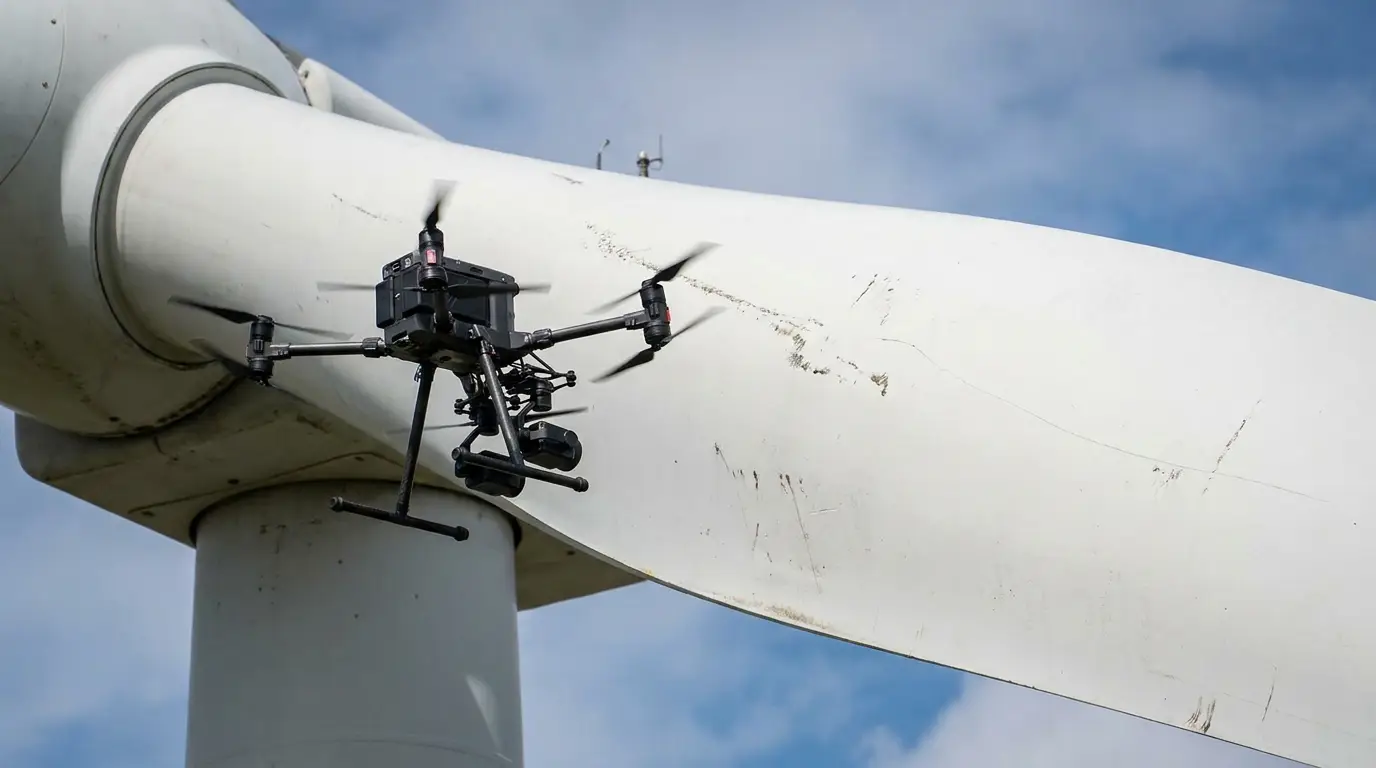
Wind Turbine Blade Inspection with Drones: Thermal vs RGB Analysis
India's commitment to renewable energy is rapidly expanding, with wind power playing a pivotal role. As the number of wind farms grows across diverse and often remote terrains, ensuring the optimal performance and longevity of these massive structures becomes increasingly critical. The integrity of wind turbine blades is paramount; even minor defects can significantly reduce efficiency, lead to costly downtime, or even catastrophic failure. Traditionally, inspecting these towering structures involved risky and time-consuming methods like rope access or ground-based binoculars. However, the advent of drone technology has revolutionized this process, offering safer, faster, and more accurate assessments.
Looking for a provider? AiRotor Labs offers wind turbine drone inspection services across India — blade, nacelle and tower inspection without rope access, ₹15,000–₹30,000 per turbine.
At AiRotor Labs, we leverage advanced Unmanned Aerial Systems (UAS) to provide comprehensive wind turbine blade inspection with drones, utilizing sophisticated sensor technology. A key question often arises when discussing these inspections: should we use thermal or RGB cameras? The truth is, both play crucial, distinct roles, and a synergistic approach often yields the most complete and actionable insights. This post delves into the capabilities of each, highlighting their unique advantages and how they contribute to a robust turbine maintenance strategy, especially within the Indian operational context.
The Imperative of Meticulous Wind Turbine Blade Inspection in India
The operational environment for wind turbines in India presents unique challenges. From coastal regions susceptible to salt erosion to high-altitude sites experiencing extreme weather, blades are constantly exposed to stresses that can lead to various forms of damage. These can include:
- Leading Edge Erosion: Caused by rain, dust, and insects, leading to aerodynamic inefficiency.
- Cracks and Delamination: Often due to fatigue, manufacturing defects, or lightning strikes, potentially compromising structural integrity.
- Lightning Strike Damage: Can cause significant surface and internal damage, weakening the blade.
- Ice Accumulation (in colder regions): Can alter aerodynamics and add significant weight.
- Manufacturing Defects: Subsurface voids or bonding issues that may not be visible externally.
Ignoring these issues can result in reduced Annual Energy Production (AEP), increased operational costs, and shortened asset lifespan. Traditional inspection methods are often slow, expensive, and expose personnel to significant risks. This makes efficient and safe wind turbine blade inspection with drones not just an advantage, but a necessity for Indian wind farm operators aiming for peak performance and safety compliance.
RGB Drones for Visual Blade Inspection: What They See
RGB (Red, Green, Blue) cameras are essentially high-resolution digital cameras, similar to those found in modern smartphones, but purpose-built for aerial data capture. When integrated into drones, they become powerful tools for capturing incredibly detailed visual information about the turbine blades.
Capabilities: RGB drones excel at identifying external, visible defects. Our drones are equipped with professional-grade cameras, such as the DJI Zenmuse P1 or the high-resolution zoom cameras found on platforms like the DJI Mavic 3 Enterprise. These sensors can capture images with resolutions upwards of 45 megapixels, allowing for:
- Detection of Surface Cracks: Even hairline fractures can be identified.
- Leading Edge Erosion Assessment: Quantifying the extent and severity of material loss.
- Lightning Strike Damage: Visualizing burn marks, splintering, and impact craters.
- Delamination (visible): Identifying areas where the outer layers of the blade are separating.
- Paint and Coating Damage: Assessing wear and tear on protective layers.
- Foreign Object Damage (FOD): Locating impacts from birds or debris.
Process and Accuracy: Our inspection drones follow pre-programmed flight paths, often circling each blade multiple times from varying angles and distances. This ensures comprehensive coverage. The high-resolution imagery allows our expert analysts to zoom in and detect defects down to sub-millimeter detail from a safe standoff distance of typically 1-3 meters from the blade surface. The collected images are then processed using specialized software to create detailed reports, including geo-referenced defect maps and severity assessments.
Limitations: While excellent for visual cues, RGB cameras cannot see beneath the surface. They are also dependent on good lighting conditions and can be hampered by fog or heavy rain, which are common challenges in certain Indian regions.
Thermal Drones for Subsurface Blade Inspection: Unveiling the Hidden
Thermal (infrared) cameras operate on a fundamentally different principle. Instead of capturing reflected visible light, they detect minute temperature differences on the surface of an object, which can indicate underlying structural issues. These cameras are crucial for identifying defects that are invisible to the naked eye or an RGB sensor.
Capabilities: Thermal drones, equipped with highly sensitive radiometric thermal cameras (e.g., DJI Zenmuse H20N, DJI M30T, or FLIR XT2 payloads), can reveal:
- Subsurface Delamination: Areas where layers within the blade are separating, creating air pockets that affect heat transfer.
- Water Ingress: Moisture trapped within the blade structure will have a different thermal signature.
- Bonding Defects: Poorly bonded internal components or repairs can show up as thermal anomalies.
- Manufacturing Voids: Air bubbles or inconsistencies from the manufacturing process.
- Internal Structural Damage: In some cases, deeper structural issues can manifest as surface temperature variations.
How it Works: The principle behind thermal inspection relies on the material's thermal properties. When a blade is exposed to solar radiation (heating) or ambient air (cooling), different materials or inconsistencies within the blade heat up or cool down at different rates. For instance, an air pocket caused by delamination will typically heat up faster and cool down slower than the surrounding solid material, creating a detectable hot or cold spot on the surface. Our thermal cameras are sensitive enough to detect temperature differentials as small as 0.05°C (known as Noise Equivalent Temperature Difference or NETD).
Process and Accuracy: Similar to RGB inspections, thermal drones follow precise flight paths. For optimal results, thermal inspections are often conducted during specific environmental conditions, such as after a period of solar loading (when the sun has warmed the blades) or during the cool-down phase. This maximizes the thermal contrast between healthy and defective areas. The thermal data is then processed to create thermograms, where anomalies are highlighted for expert interpretation.
Limitations: Thermal imaging can be influenced by external factors like surface contamination (dust, dirt), varying emissivity of different blade materials, or adverse weather conditions (heavy cloud cover reducing solar loading). Expert interpretation is crucial to distinguish true defects from environmental artifacts.
Combining Forces: The Power of Thermal and RGB Synergy
While both RGB and thermal analyses are powerful on their own, their combined application provides the most comprehensive picture of blade health. This synergistic approach allows for:
- Complete Damage Assessment: RGB identifies all visible surface defects, while thermal uncovers hidden subsurface issues. A minor surface crack detected by RGB might, for example, be indicative of a much larger delamination beneath, revealed by thermal.
- Enhanced Diagnostics: Cross-referencing data from both sensors allows for more accurate root cause analysis. A dark spot on an RGB image could be mere dirt, but if it also shows a thermal anomaly, it points to a more serious structural issue.
- Predictive Maintenance: By identifying both overt and covert damage early, operators can schedule repairs proactively, preventing escalation of minor defects into major failures. This significantly reduces unscheduled downtime and extends asset life.
- Efficient Workflow: Many modern inspection drones, like the DJI M30T or M350 RTK with H20N payload, can carry both RGB and thermal cameras simultaneously. This means a single drone flight can capture all necessary data, streamlining the inspection process and reducing field time.
At AiRotor Labs, our standard wind turbine blade inspection with drones protocol often integrates both thermal and RGB sensors to deliver a holistic view of blade integrity, ensuring no defect goes unnoticed.
Operational Aspects and DGCA Regulations in India
Implementing drone-based inspections in India requires adherence to specific operational guidelines and regulations set forth by the Directorate General of Civil Aviation (DGCA).
Efficiency and Safety:
- Speed: A single wind turbine blade inspection with drones can typically be completed in 1-2 hours, compared to days for rope access teams. This drastically reduces turbine downtime.
- Safety: Eliminates the need for humans to work at height, significantly reducing occupational hazards.
- Cost-Effectiveness: Faster inspections, reduced labor costs, and proactive maintenance contribute to substantial long-term savings.
DGCA Regulations (UAS Rules 2021, amended 2022): AiRotor Labs operates strictly within the framework of the DGCA's Unmanned Aircraft System (UAS) Rules. Key requirements include:
- Remote Pilot Certificate: All our drone pilots hold valid Remote Pilot Certificates (RPCS) issued by DGCA-approved Flying Training Organizations.
- Digital Sky Platform: All drone operations require prior permission and are managed through the Digital Sky platform, ensuring compliance with no-fly zones, restricted areas, and specific operational guidelines.
- Visual Line of Sight (VLOS): Most commercial drone operations in India are currently restricted to Visual Line of Sight, meaning the pilot must maintain direct visual contact with the drone at all times. For large wind farms, this requires careful flight planning and potentially multiple launch points. While Beyond Visual Line of Sight (BVLOS) operations are being trialed, VLOS remains the standard for commercial inspections.
- Drone Registration: All our drones are registered and possess Unique Identification Numbers (UIN) and other necessary permits.
Compliance with these regulations is not just a legal necessity but also a testament to our commitment to safe and professional operations, providing peace of mind to our clients in the Indian renewable energy sector.
Conclusion
The choice between thermal and RGB analysis for wind turbine blade inspection with drones isn't an either/or proposition. Both are indispensable tools, each offering a unique perspective on blade health. RGB cameras provide critical visual detail for surface defects, while thermal cameras unveil hidden subsurface anomalies that could evolve into major structural issues. By integrating both technologies, AiRotor Labs delivers a comprehensive, highly accurate, and efficient inspection solution that safeguards your wind assets, maximizes energy production, and minimizes operational risks in India's dynamic renewable energy landscape.
Ensure the longevity and efficiency of your wind turbines. Partner with AiRotor Labs for advanced drone inspection services.
Contact us today to schedule your comprehensive wind turbine blade inspection: https://www.airotor.in/booking
AiRotor Labs provides drone-based inspection, aerial survey, and land survey across India.
Book a consultation →