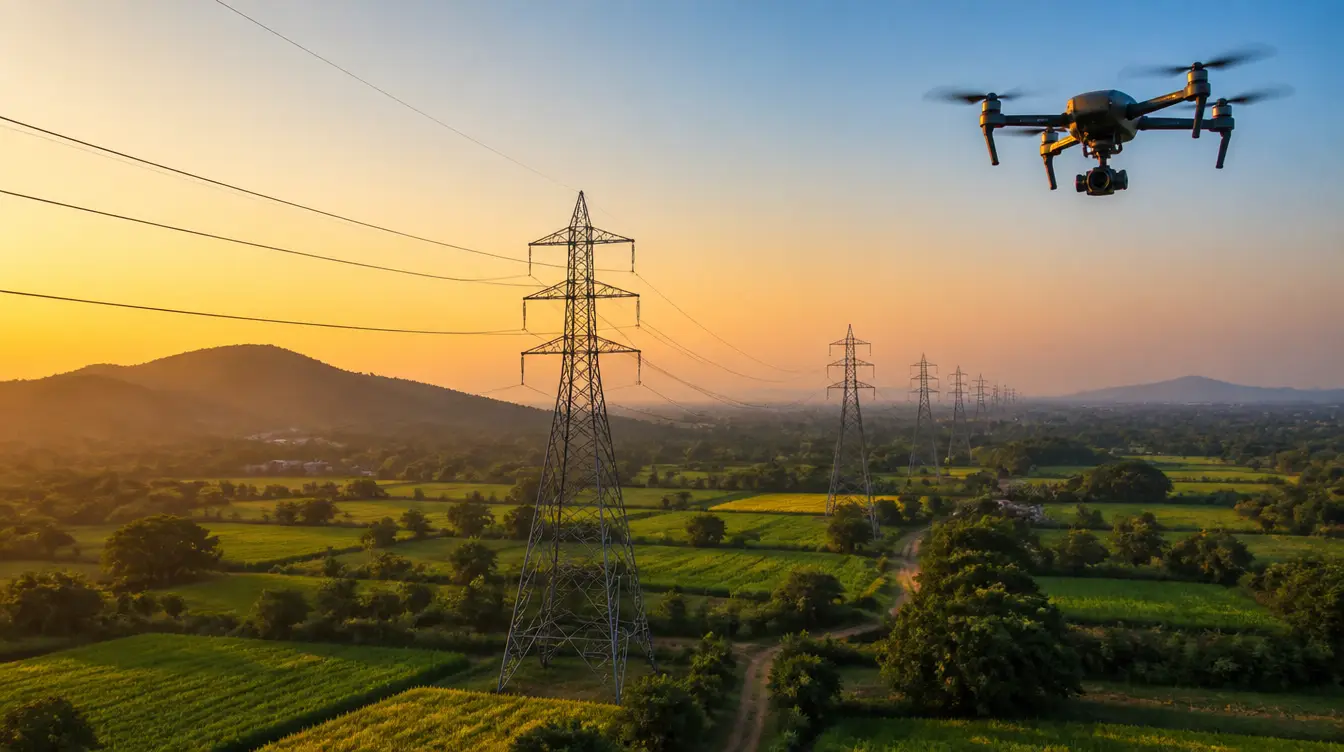
Revolutionising Powerline Inspection: BVLOS Drone Operations for Long-Distance Patrol in India
India's energy infrastructure is the backbone of its economic growth, with an ever-expanding network of power transmission lines stretching across diverse and often challenging terrains. Ensuring the integrity and reliability of these lines is paramount, yet traditional inspection methods present significant hurdles. From dense forests and remote mountains to vast agricultural lands, the sheer scale and complexity of patrolling these critical assets manually are immense. This is where Beyond Visual Line of Sight (BVLOS) drone operations for long-distance powerline patrol in India emerge as a game-changer, offering a safer, more efficient, and data-rich alternative.
Looking for a provider? AiRotor Labs offers transmission line drone inspection services across India — thermal, LiDAR and corona inspection of live lines, ₹5,000–₹15,000 per km.
The Inherent Challenges of Traditional Powerline Inspection
Historically, powerline inspection in India has relied on a combination of ground patrols and, for more critical sections, manned helicopter inspections. While these methods have served their purpose, they come with substantial drawbacks:
- Safety Risks: Manual inspection exposes personnel to dangerous environments, including working at heights, navigating difficult terrain, and the inherent risks associated with high-voltage infrastructure. Helicopter inspections, while faster, carry their own set of aviation safety concerns.
- Inefficiency and Time Consumption: Ground patrols are slow, labor-intensive, and weather-dependent, meaning vast sections of lines can take weeks or even months to cover. Helicopters offer speed but are limited by flight duration, operational costs, and the need for significant logistical support.
- Accessibility Issues: Many powerlines traverse remote, inaccessible regions – dense jungles, deserts, and mountainous areas – making physical access extremely difficult and costly for human teams and even challenging for helicopters due to terrain and weather.
- High Operational Costs: Manned helicopter operations are notoriously expensive, involving high fuel costs, maintenance, and skilled pilot fees. Ground patrols, while seemingly cheaper per kilometer, accumulate significant costs over time due to labor and extended durations.
- Subjective Data Collection: Manual inspections often rely on visual observations, which can be subjective and inconsistent. Gathering precise, quantitative data for predictive maintenance and trend analysis is challenging.
These limitations highlight a clear need for a more advanced, scalable, and safer approach to powerline monitoring across India's vast grid.
Understanding BVLOS Drone Operations in the Indian Context
BVLOS refers to drone flights where the drone operates beyond the pilot's direct visual line of sight. For long-distance infrastructure like powerlines, BVLOS capability is not just an advantage – it's a necessity. It enables drones to cover hundreds of kilometers in a single mission, drastically reducing inspection times and costs.
In India, the Directorate General of Civil Aviation (DGCA) has progressively evolved its regulatory framework to facilitate commercial drone operations, including BVLOS. The Drone Rules, 2021, and subsequent amendments provide the foundational structure. While BVLOS operations require specific permissions, detailed flight plans, and often involve advanced drone systems and certified pilots, the regulatory environment is maturing to support such critical applications. Companies like AiRotor Labs work closely with regulatory bodies, ensuring all missions strictly comply with DGCA guidelines, including obtaining necessary Unique Identification Numbers (UINs) for drones, Unmanned Aircraft Operator Permits (UAOPs), and specific flight permissions for BVLOS routes through platforms like Digital Sky. This adherence to regulations is crucial for safe and legal BVLOS drone operations for long-distance powerline patrol in India.
How BVLOS Drones Revolutionise Powerline Patrol
The adoption of BVLOS drones marks a paradigm shift in powerline inspection, bringing unparalleled benefits:
1. Enhanced Safety
The primary advantage is the removal of human personnel from hazardous environments. Drones perform the risky work, significantly reducing the potential for accidents and injuries associated with live powerlines or difficult terrain.
2. Unmatched Efficiency and Speed
BVLOS drones, particularly fixed-wing or hybrid VTOL (Vertical Take-off and Landing) models designed for endurance, can cover extensive linear distances rapidly. A single drone team can typically inspect 50-100 kilometers of powerlines per day, a stark contrast to the few kilometers per day by ground patrol or the limited range of VLOS (Visual Line of Sight) drones. This speed translates directly into faster identification of faults, reduced downtime, and improved grid reliability.
3. Superior Data Collection and Analysis
This is where drones truly excel. Equipped with advanced payloads, they capture high-resolution, precise data:
- High-Resolution RGB Cameras: For visual inspection of components like insulators, conductors, tower structures, and identifying physical damage, corrosion, or foreign objects. Ground Sample Distance (GSD) can be as fine as 0.5-2 cm, providing incredible detail.
- Thermal Cameras: Critical for detecting "hot spots" – anomalies indicating overheating components, loose connections, or failing insulators. Advanced thermal sensors can detect temperature differences as small as 0.05°C, allowing for proactive maintenance before failures occur.
- LiDAR (Light Detection and Ranging): Generates highly accurate 3D point clouds of the powerline corridor. This data is invaluable for:
- Vegetation Management: Precisely identifying vegetation encroachment, predicting growth, and planning trimming operations. Accuracy can be within 5-10 cm for point cloud data.
- Sag and Tension Analysis: Measuring conductor sag and calculating tension, ensuring compliance with clearance regulations.
- Structural Integrity: Detailed 3D models of towers to assess structural health and identify deformation.
- ROW (Right-of-Way) Infringement: Detecting new constructions or activities within the powerline corridor.
- Gas Leak Detection (Optional): Specialized sensors can detect SF6 gas leaks from circuit breakers, an important environmental and operational concern.
The collected data is then processed using AI and machine learning algorithms to automate defect detection, classify anomalies, and generate detailed reports and digital twins of the powerline infrastructure. This quantitative data allows utilities to move from reactive repairs to predictive, condition-based maintenance strategies.
4. Significant Cost Savings
While the initial investment in BVLOS drone technology might seem substantial, the long-term cost savings are undeniable. Reduced reliance on expensive manned helicopters, lower labor costs for inspections, and prevention of costly outages through proactive maintenance quickly lead to a positive return on investment.
Implementing BVLOS Drone Solutions for Powerlines: Key Considerations
Deploying effective BVLOS drone operations for long-distance powerline patrol in India requires careful planning and expertise:
- Regulatory Compliance: As mentioned, strict adherence to DGCA regulations for BVLOS flights is non-negotiable. This involves obtaining necessary permits, adhering to flight height and time restrictions, and operating in designated airspaces.
- Advanced Drone Platforms: Long-distance missions necessitate drones with extended flight times (typically 1.5-3+ hours), robust navigation systems, redundant communication links (radio, cellular, satellite), and often, parachute recovery systems for added safety. Fixed-wing or hybrid VTOL designs are generally preferred for their efficiency over distance.
- Specialized Payloads: The selection of sensors must be tailored to the specific inspection objectives (e.g., thermal for hot spots, LiDAR for vegetation, high-res RGB for visual defects).
- Skilled Personnel: Operating BVLOS drones requires highly trained and DGCA-certified pilots, experienced data analysts, and maintenance technicians capable of managing complex aerial systems and interpreting intricate datasets.
- Robust Data Management and Analytics: Handling terabytes of data from continuous inspections requires robust cloud-based platforms for storage, processing, and AI-driven analysis. Seamless integration with the utility's existing asset management systems is crucial for actionable insights.
- Logistics and Field Operations: Efficient battery management, mobile ground control stations, and field repair capabilities are essential for sustaining long-duration BVLOS operations in remote areas.
The Future is Clear: Drone Patrol for India's Power Grid
The move towards advanced drone technology, particularly BVLOS capabilities, is not just an upgrade but a fundamental transformation in how India's critical power infrastructure will be monitored and maintained. It promises a future where power outages are fewer, maintenance is proactive, and the safety of personnel is never compromised. The ability of BVLOS drone operations for long-distance powerline patrol in India to deliver precise, actionable data across vast distances makes it an indispensable tool for utilities striving for greater efficiency, reliability, and safety.
At AiRotor Labs, we are at the forefront of deploying advanced BVLOS drone solutions for critical infrastructure inspection across India. Our expertise in navigating DGCA regulations, coupled with cutting-edge drone technology and data analytics, enables us to provide unparalleled insights for power transmission and distribution companies. We're committed to helping India's energy sector embrace the future of inspection with safety, precision, and efficiency.
Ready to explore how BVLOS drone solutions can transform your powerline inspection strategy? Contact AiRotor Labs today to discuss your specific requirements and receive a tailored consultation.
Book a Consultation with AiRotor Labs
AiRotor Labs provides drone-based inspection, aerial survey, and land survey across India.
Book a consultation →