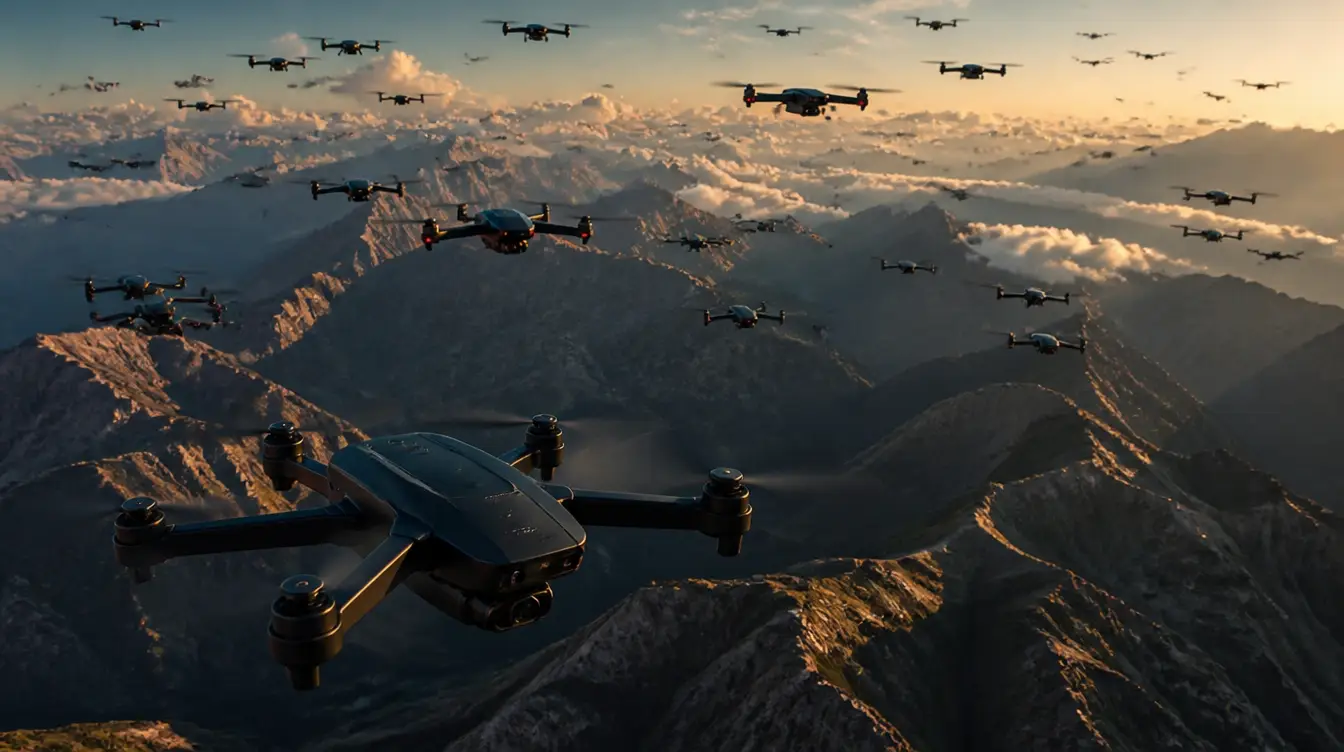
Drone swarms are no longer science fiction. Across the world, defence establishments are fielding coordinated groups of autonomous UAVs capable of overwhelming air-defence radars, executing precision strikes, conducting surveillance over vast terrain, and resupplying troops in contested zones — simultaneously, with no individual operator managing each platform. The technology has matured faster than most defence analysts predicted, and India, with its unique strategic geography and ambition to become a major defence exporter, is moving quickly to catch up.
This article breaks down how drone swarm technology works for defence applications, where the technology stands today, what India is doing, and what the realistic next decade looks like.
What Makes a Drone Swarm Different from a Fleet
The word "swarm" gets overused. A swarm is not simply multiple drones operating at the same time. True swarm technology refers to a group of UAVs that share situational awareness, coordinate autonomously without operator-per-drone control, and adapt collectively to changing conditions — much like a flock of starlings executing complex manoeuvres without a leader.
Three layers define a genuine swarm:
Decentralised command. No single node controls the group. Each drone makes local decisions based on shared data, and the swarm remains functional if half the units are destroyed or jammed. This is the opposite of a standard UAS fleet where one ground station losing connection grounds the entire mission.
Shared situational awareness. Drones continuously broadcast position, sensor data, and mission status to each other over a mesh network. Every unit knows what every other unit sees. Target data from a forward drone is instantly available to the unit behind it about to engage.
Emergent collective behaviour. Tasks like surrounding a target, saturating an air-defence system, or building a persistent surveillance net arise from simple rules each drone follows — no central script needed. The swarm self-organises around mission objectives.
Current Indian MALE (Medium Altitude Long Endurance) platforms like the DRDO-developed Rustom-2 and platforms procured from Israel operate as individual assets. The leap to coordinated swarms requires not just more drones but a completely different software architecture, communications protocol, and doctrine.
Current Military Applications of Drone Swarms
Saturation and Suppression of Air Defences
The most discussed offensive application is using a swarm to overwhelm integrated air-defence systems (IADS). Modern IADS — like S-400 batteries or Patriot systems — can track and engage multiple targets simultaneously, but they have finite intercept rates. A swarm of 50–200 low-cost UAVs, some carrying electronic jamming payloads and others carrying submunitions, can exceed the system's engagement capacity. Even destroying 80% of the swarm may still allow the remaining units to reach their targets.
Ukraine's use of locally produced Bober and Shark drones in coordinated attacks on Russian air-defence sites demonstrated early versions of this saturation concept. China's CH-901 "loitering munition swarm" system, showcased publicly, deploys tube-launched UAVs from vehicle-mounted launchers that self-organise after ejection.
Persistent Area Surveillance
Surveillance swarms work differently. Instead of a single high-value ISR asset like a Heron TP flying a predictable orbit — a prime target — multiple small drones cover the same area in rotating relays. Each drone carries a smaller sensor suite (electro-optical, infrared, or signals intelligence), but the collective picture matches or exceeds what a single large platform provides, without presenting a single point of failure.
The US Air Force's Collaborative Combat Aircraft (CCA) programme, which pairs manned F-35s with autonomous wingman drones, is an advanced version of this concept for contested airspace.
Logistics in Denied Terrain
A less-discussed but militarily critical application is swarm-based resupply. Multiple drones carrying fragmented loads of ammunition, blood products, or communications relay equipment can reach surrounded positions where a single helicopter would be shot down. If one or two are intercepted, the rest deliver. This was operationally demonstrated during several phases of the Russia-Ukraine conflict.
Decoy and Deception Operations
Electronic warfare swarms — UAVs emitting radar cross-sections mimicking aircraft or generating spoofed signals — can confuse adversary radar and divert expensive interceptors away from real strike packages. A ₹5 lakh decoy drone absorbing a ₹10 crore missile represents a significant attrition exchange in the attacker's favour.
India's Drone Swarm Development Landscape
India's defence establishment has made swarm technology a stated priority. The DRDO's Centre for Artificial Intelligence and Robotics (CAIR) in Bengaluru has been leading swarm coordination research since approximately 2019. In early 2022, DRDO conducted a demonstration of a 25-drone swarm operating with shared coordination logic, a milestone that received significant coverage but limited operational detail.
IDIPT (Integrated Drone Inspection and Patrolling Technologies), a Defence India Start-up Challenge initiative, has generated several private-sector entrants building swarm coordination middleware. Companies like Ideaforge, Garuda Aerospace, and several deep-tech startups with defence focus are developing platforms that could serve as swarm nodes.
The Indian Navy's interest in maritime swarms for coastal surveillance and vessel tracking is significant given India's 7,500 km coastline. A persistent swarm network of low-cost, solar-augmented UAVs maintaining round-the-clock coverage of key maritime approaches is actively being evaluated.
For terrestrial border surveillance, the BSF and Army are exploring swarms to address the limitations of fixed camera towers — which have known dead zones and are vulnerable to targeted destruction — with a distributed, redundant, and self-healing aerial surveillance mesh.
AiRotor Labs works at the operational intersection of commercial and defence-adjacent drone capabilities, and the progression from precision inspection drones to coordinated multi-platform operations represents a technology continuum our engineering team follows closely.
Key Technology Challenges That Remain Unsolved
Spectrum Management and Anti-Jam Communications
Swarms require reliable mesh communications in contested electromagnetic environments. Military adversaries will attempt to jam, spoof, or intercept swarm networks. Current solutions involve frequency hopping, directional RF links, and LiDAR-based communication for short-range coordination — but none are fully reliable against sophisticated jamming. India's contested northern borders, where Chinese electronic warfare capability is assumed to be advanced, make this particularly acute.
Rules of Engagement and Autonomous Lethal Decision-Making
Lethal autonomous weapons systems (LAWS) — drones that autonomously identify and kill targets without human authorisation — remain deeply controversial internationally. India has not signed onto any moratorium, but domestic doctrine for when a swarm drone may autonomously engage remains unclear. For surveillance and logistics swarms, this is not an issue; for offensive swarms, it is the central unresolved question.
Counter-Swarm Systems
As swarm capability spreads, so does counter-swarm technology. Directed energy weapons (high-powered microwave systems like the US THOR programme), kinetic interceptors, and AI-driven counter-swarm drones are all in development. India's own DRDO has a counter-drone programme that has demonstrated laser dazzler and RF-jamming capabilities against single drones; extending this to multi-target swarm threats is a work in progress.
Cost and Attrition Tolerance
Swarms are only tactically viable if individual units are cheap enough to accept significant attrition. The US military's Perdix micro-drone costs roughly USD 15,000–20,000 per unit. India's aspirational cost target for expendable swarm nodes is closer to ₹3–5 lakh per unit. Achieving the sensor capability, communications reliability, and propulsion endurance at that price point remains a manufacturing challenge.
What the Next Decade Looks Like
By 2035, several developments are near-certain based on current trajectories:
Swarms will be standard in major military inventories. The US, China, Russia, Israel, Turkey, and likely India will have operational swarm capabilities across ISR, strike, and logistics roles. The question is doctrine, not technology.
India will deploy maritime swarm surveillance networks. Given the Navy and Coast Guard's stated needs and the relative maturity of the technology for non-lethal surveillance roles, a coastal swarm network is the most likely near-term operational deployment. Expect pilot programmes around the Andaman and Nicobar Islands, given their strategic sensitivity.
Commercial drone infrastructure will underpin military logistics swarms. The development of drone delivery corridors under India's Drone Airspace Map and the PM Gati Shakti framework is creating the urban air traffic management infrastructure that military logistics planners will leverage. The technical standards, spectrum allocations, and detect-and-avoid systems developed for commercial use directly transfer.
Human-on-the-loop rather than human-out-of-the-loop will dominate. For the foreseeable future, most operational swarms will require a human operator to authorise lethal action, with the swarm executing autonomously once authorised. Full autonomy for kinetic missions will remain operationally restricted, if not formally prohibited, across most democratic militaries.
Counter-swarm becomes a primary air-defence requirement. Every air-defence procurement decision in the next decade will evaluate counter-swarm capability alongside conventional missile defence. This opens a significant market for Indian defence electronics companies.
Strategic Implications for Indian Defence Procurement
India's unique challenge is acquiring cutting-edge swarm capability while simultaneously building indigenous production capacity. The iDEX (Innovations for Defence Excellence) framework has created a pipeline, but the gap between laboratory demonstrators and field-deployable systems remains wide. The US-India Defence Technology and Trade Initiative (DTTI) offers a potential shortcut for some technologies, but autonomous weapons systems are particularly sensitive in bilateral transfers.
For the Indian private sector, swarm technology represents the single largest emerging opportunity in defence UAV manufacturing. Unlike traditional defence procurement — dominated by large PSUs with long procurement cycles — swarm nodes are small, software-intensive platforms where agile private companies have a genuine edge. The DRDO partnership model is evolving to accommodate this, though slowly.
AiRotor Labs and other commercial drone operators contribute to this ecosystem not just through direct defence work but by developing the operational expertise, sensor integration knowledge, and real-world flight data that inform defence requirements.
The Path Forward
Drone swarm technology for defence is past the proof-of-concept stage and entering the operational doctrine stage. The hardware works. The software frameworks exist. The remaining challenges are electromagnetic hardening, international legal frameworks, counter-swarm systems, and cost reduction — each significant, none insurmountable.
For India specifically, the opportunity is to leapfrog some legacy ground system investments by building swarm-native surveillance and logistics capability that suits the country's specific strategic geography: long land borders with two nuclear-armed adversaries, a vast coastline, and significant internal security requirements in diverse terrain.
The drone industry's role in this transition extends well beyond defence contractors. Understanding swarm architecture, autonomous coordination, and multi-platform operations will be foundational knowledge for any serious UAV operator in the coming decade.
To learn more about AiRotor Labs' drone services and how advanced aerial systems are being applied across inspection, surveillance, and survey missions, visit https://www.airotor.in/booking to discuss how precision drone operations can serve your project or organisation.
AiRotor Labs provides drone-based inspection, aerial survey, and land survey across India.
Book a consultation →