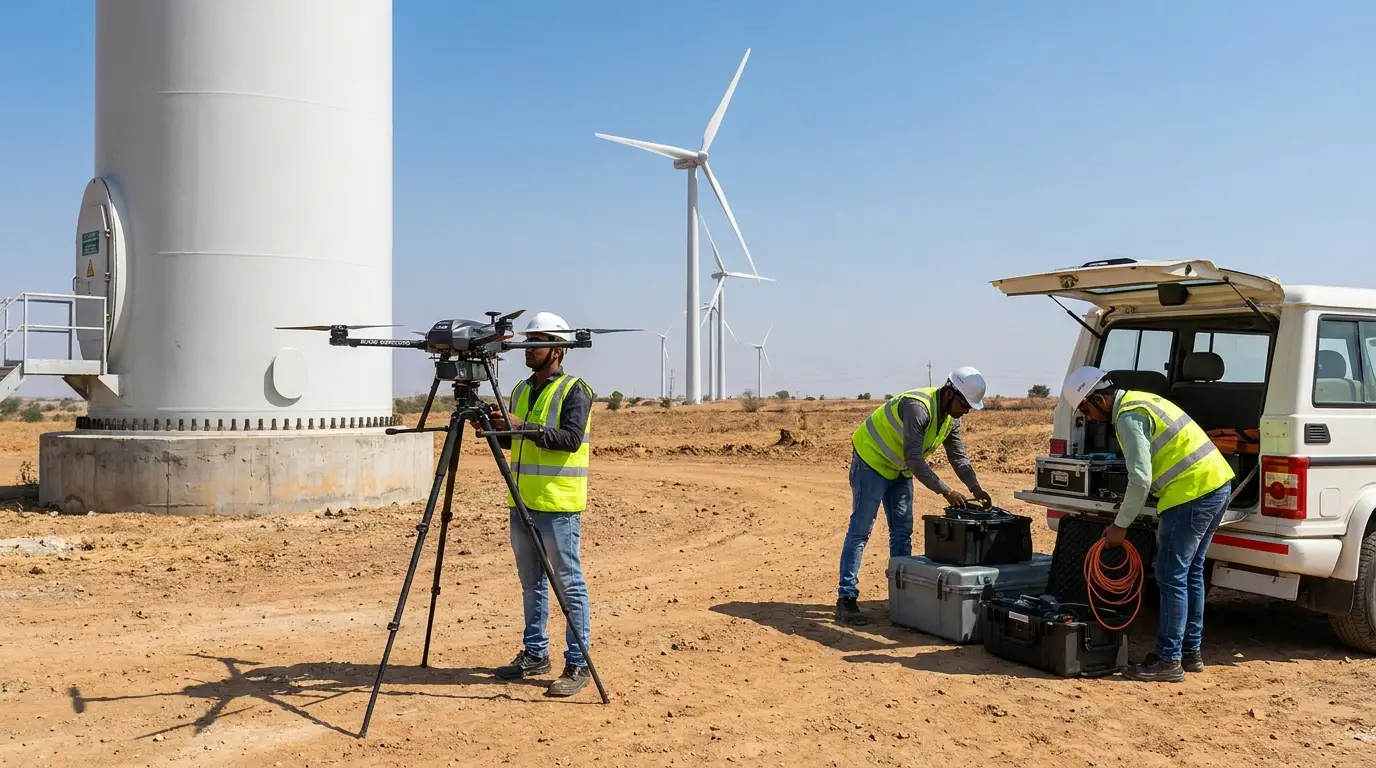
Wind Turbine Drone Inspection Cost in India: ₹15,000–30,000 per Turbine (2026)
India's installed wind capacity crossed 47 GW in early 2026, and the sector is adding roughly 3–4 GW every year. With over 40,000 turbines now operating across the country — many of them past the 10-year mark — inspection and maintenance spending has become one of the largest recurring costs for wind farm owners. The most consequential shift in this space over the last five years has been the move from manual rope-access teams to drone-based inspection, which delivers faster, safer, and significantly cheaper results.
Looking for a provider? AiRotor Labs offers wind turbine drone inspection services across India — blade, nacelle and tower inspection without rope access, ₹15,000–₹30,000 per turbine.
If you are evaluating wind turbine drone inspection cost for your assets in India, this guide gives you the actual numbers: per-turbine pricing, scope-based packages, cost comparisons with legacy methods, and practical strategies to reduce your annual spend.
What Does Wind Turbine Drone Inspection Cost Per Turbine in India?
The short answer: Rs 15,000 to Rs 30,000 per turbine for a standard drone inspection in 2026, depending on the scope and site conditions. That figure covers mobilisation, autonomous flight, high-resolution image capture, AI-assisted defect analysis, and a detailed report.
Here is how the pricing breaks down by scope:
| Inspection Scope | Typical Cost Per Turbine (Rs) | What Is Included |
|---|---|---|
| Blade-only RGB inspection | 15,000 – 20,000 | All blades imaged on 4 surfaces (leading edge, trailing edge, pressure side, suction side); AI defect detection; severity-classified report |
| Full turbine inspection (blades + tower + nacelle) | 22,000 – 30,000 | Blade inspection plus tower surface condition, nacelle exterior, foundation base imaging |
| Blade inspection with thermal overlay | 20,000 – 28,000 | Standard blade inspection plus thermal imaging for subsurface delamination and moisture ingress detection |
These rates are for standard onshore turbines with hub heights between 60 m and 120 m. Taller turbines or offshore installations carry a premium.
By contrast, the equivalent rope-access inspection for a single turbine costs between Rs 60,000 and Rs 1,50,000, factoring in crew mobilisation, safety equipment, turbine downtime, and the 4–6 hours each turbine remains offline.
Cost Comparison: Drone vs Rope Access vs Ground Telescope
Wind farm operators in India typically choose between three inspection methods. The table below compares them on cost, coverage, and operational impact.
| Factor | Drone Inspection | Rope Access / Abseiling | Ground-Based Telescope |
|---|---|---|---|
| Cost per turbine | Rs 15,000 – Rs 30,000 | Rs 60,000 – Rs 1,50,000 | Rs 5,000 – Rs 10,000 |
| Inspection time per turbine | 20–40 minutes | 4–6 hours | 30–60 minutes |
| Turbine downtime required | Minimal (rotor lock only) | Full shutdown, 4–6 hrs | None |
| Defect detection accuracy | High (sub-mm resolution at close range) | High (visual, tactile) | Low (limited resolution, misses small defects) |
| Coverage | Full — all blade surfaces, tower, nacelle | Partial — limited by rope positioning | Partial — only ground-facing surfaces visible |
| Safety risk | Low (operator on ground) | High (working at 80–120 m height) | Low |
| Data for trending | Yes — georeferenced, repeatable, AI-analysed | Limited — subjective, variable framing | Very limited |
| Turbines inspected per day | 6–10 | 1–2 | 4–6 |
Ground-based telescope inspection is the cheapest upfront but misses the majority of defects that matter — leading-edge erosion, hairline cracks, lightning entry/exit points, and trailing-edge bond-line openings. It is adequate only as a preliminary screening method, not as a primary inspection tool.
Rope access delivers hands-on defect confirmation and allows immediate minor repairs, but the cost is 3x–5x higher than drone inspection, and the downtime revenue loss adds significantly to the true expense.
Drone inspection occupies the practical middle ground: it provides full-surface, high-resolution, AI-analysed data at a fraction of the rope-access cost. For most wind farm operators in India, it is now the default choice for scheduled annual inspections.
Factors That Affect Wind Turbine Drone Inspection Cost
Not every inspection costs the same. The main variables that shift pricing are:
1. Turbine Height and Rotor Diameter
Turbines with hub heights above 100 m or rotor diameters exceeding 130 m require longer flight times and more image frames per blade. Modern 3 MW+ turbines with 70-metre blades take roughly 35–40 minutes per turbine versus 20 minutes for older sub-MW machines with shorter blades. Expect a 15–25% cost increase for large-rotor turbines.
2. Number of Turbines (Volume)
This is the single biggest lever on per-turbine cost. A 5-turbine inspection will cost more per unit than a 100-turbine wind farm contract. Mobilisation, logistics, and crew travel costs are amortised across more turbines at scale. Volume-based pricing typically looks like this:
| Turbine Count | Indicative Cost Per Turbine (Rs) |
|---|---|
| 1–10 turbines | 25,000 – 30,000 |
| 11–50 turbines | 20,000 – 25,000 |
| 51–100 turbines | 17,000 – 22,000 |
| 100+ turbines | 15,000 – 20,000 |
3. Inspection Scope
A blade-only visual inspection is the base package. Adding thermal imaging, tower and nacelle coverage, foundation inspection, or yaw-system exterior checks increases the scope and the cost. For a comprehensive guide on blade-specific inspection, see our detailed post on wind turbine blade inspection.
4. Site Location and Accessibility
India's wind corridors are spread across geographically diverse terrain, and mobilisation costs vary accordingly:
- Gujarat (Kutch): India's largest wind cluster. Remote sites in the Rann of Kutch require longer travel from Bhuj or Gandhidham, but the sheer concentration of turbines makes large-volume contracts cost-effective.
- Tamil Nadu (Muppandal, Kayathar, Aralvaimozhi): Dense wind corridors in the southern tip with relatively good road access. High turbine density keeps per-unit costs competitive.
- Rajasthan (Jaisalmer, Barmer): Arid terrain with long distances between wind farm clusters. Desert conditions can limit flight windows to early morning hours, slightly extending project timelines.
- Karnataka (Chitradurga, Davangere, Gadag): Moderate accessibility with wind farms spread across the Deccan Plateau. Terrain is manageable, and most sites are within reasonable distance of regional airports.
Sites that are more than 200 km from the nearest operational base add Rs 2,000–5,000 per turbine in mobilisation costs. Multi-site contracts in the same region help absorb this.
5. Reporting Depth and Analytics
A basic defect report with classified images costs less than a full analytics package that includes blade-mapping, defect trending against previous inspections, severity scoring, and maintenance priority recommendations. Operators running ongoing programmes benefit from the deeper analytics, but one-time inspections can use the standard report tier to keep costs down.
ROI Calculation: What Does Drone Inspection Save You?
The economics are straightforward. Consider a 50-turbine wind farm using 2 MW machines:
Drone inspection cost: 50 turbines x Rs 22,000 = Rs 11,00,000
Equivalent rope-access cost: 50 turbines x Rs 1,00,000 = Rs 50,00,000
Direct saving: Rs 39,00,000 per inspection cycle
But the direct cost difference understates the real ROI. The larger savings come from:
Reduced downtime revenue loss. Each turbine shut down for rope access loses 4–6 hours of generation. At a capacity factor of 25% and a tariff of Rs 3.50/kWh, a 2 MW turbine generates roughly Rs 3,500–5,000 of revenue per hour. For 50 turbines, 5 hours of downtime each translates to Rs 8,75,000–12,50,000 in lost generation. Drone inspection avoids nearly all of this.
Early defect detection. A leading-edge erosion defect caught early can be repaired in-situ for Rs 50,000–80,000. Left undetected for 12–18 months, the same defect can degrade into a structural crack requiring a blade replacement costing Rs 25,00,000–40,00,000 per blade. A single prevented blade failure pays for years of drone inspections.
Insurance and warranty compliance. Many OEM warranty agreements and insurance policies now require documented periodic inspections. Drone inspection provides timestamped, georeferenced, AI-analysed evidence that satisfies these requirements at the lowest cost.
Conservative total annual saving for a 50-turbine farm: Rs 50,00,000–65,00,000 when factoring in direct cost reduction, downtime avoidance, and early defect intervention.
Pricing for Different Inspection Packages
Most drone inspection providers in India — including AiRotor Labs — offer tiered packages to match different operational needs:
Blade-Only Inspection
- Scope: All three blades, four surfaces each (leading edge, trailing edge, pressure side, suction side)
- Deliverable: Defect-mapped blade diagram, classified images, severity ratings
- Best for: Annual scheduled inspections, warranty compliance checks
- Cost: Rs 15,000–20,000 per turbine
Full Turbine Inspection
- Scope: Blades + tower surface + nacelle exterior + foundation base
- Deliverable: Complete turbine condition report covering structural, surface, and hardware integrity
- Best for: Pre-acquisition due diligence, post-warranty transition assessments, insurance renewals
- Cost: Rs 22,000–30,000 per turbine
Wind Farm Package (Annual Contract)
- Scope: Full portfolio inspection on an annual or semi-annual cycle, with trending and analytics
- Deliverable: Farm-level dashboard, turbine-by-turbine defect history, maintenance priority matrix, executive summary
- Best for: IPPs, asset managers, and O&M contractors managing 50+ turbines
- Cost: Rs 15,000–22,000 per turbine (volume-discounted)
For operators who also manage solar assets, bundling wind and solar panel inspection services under a single contract often yields additional savings of 10–15% across both programmes.
How to Reduce Your Wind Turbine Inspection Costs
Operators looking to bring per-turbine costs below the Rs 20,000 mark should consider these strategies:
1. Sign Annual or Multi-Year Contracts
Single inspections carry full mobilisation and planning overhead. An annual contract locks in volume pricing and lets the inspection provider optimise logistics across multiple visits. Two- and three-year agreements typically offer 10–20% lower rates than one-off engagements.
2. Bundle Multiple Sites
If you operate wind farms across multiple states — for example, assets in Kutch and Jaisalmer — bundling them into a single contract allows the provider to plan regional campaigns that reduce travel costs per turbine.
3. Combine Inspection Types
Wind farm operators who also need land survey services for new project sites or access-road planning can bundle these with turbine inspections. Shared mobilisation cuts the marginal cost of each additional service.
4. Schedule During Optimal Weather Windows
Wind corridors in India have distinct seasonal patterns. Inspections scheduled during low-wind periods — typically April to June in most corridors — allow more turbines to be inspected per day (fewer weather holds), bringing the effective per-turbine cost down.
5. Use Volume Tiers Strategically
If your portfolio sits just below a volume tier threshold (for example, 45 turbines versus the 51-turbine tier break), it can be cost-effective to add nearby turbines from a partner or co-located farm to reach the lower pricing bracket.
What to Look for in a Drone Inspection Provider
Price is important, but it should not be the only criterion. The value of an inspection depends on data quality, analytical depth, and operational reliability. Key factors to evaluate:
- Sensor quality: Sub-millimetre resolution at inspection distance is essential for detecting early-stage erosion and hairline cracks. Low-resolution imagery produces clean-looking reports that miss the defects that matter.
- AI-assisted analysis: Manual image review is subjective and slow. Providers using trained defect-detection models deliver more consistent, faster, and more comprehensive results.
- Regulatory compliance: DGCA-compliant operations with proper Remote Pilot Certificates, UAS operator permits, and site-specific flight approvals are non-negotiable.
- Reporting standards: Reports should classify defects by type and severity, map them spatially on the blade, and provide actionable maintenance recommendations — not just a folder of photographs.
- Trending capability: If you plan to inspect annually, the provider should be able to overlay current findings against previous inspections to track defect progression over time.
Why Wind Farm Operators Work with AiRotor Labs
AiRotor Labs provides drone-based wind turbine inspection services across India's major wind corridors, with operational presence in Gujarat, Tamil Nadu, Rajasthan, and Karnataka. Our approach is built around three priorities:
Accurate data. We fly close-range autonomous missions using high-resolution RGB and thermal sensors. Every image is captured at a consistent distance and angle, producing the repeatable dataset that meaningful defect trending requires.
AI-powered analysis. Our proprietary AiServe software processes inspection imagery through trained defect-detection models, classifying erosion, cracks, lightning damage, surface contamination, and bond-line defects by type and severity. This reduces turnaround time from weeks to days and catches defects that manual review misses.
Transparent pricing. We publish our pricing tiers, honour volume commitments, and do not add hidden charges for travel or reporting. Operators know exactly what they are paying before the first flight.
Whether you manage a 10-turbine site in Chitradurga or a 200-turbine portfolio spread across Kutch and Jaisalmer, we structure contracts to deliver the best per-turbine economics at the inspection depth your assets require.
Get a quote for your wind farm. Contact AiRotor Labs to receive a detailed cost estimate based on your turbine count, locations, and inspection scope. We typically respond within 24 hours with a fixed-price proposal.
Visit airotor.in or reach out directly to discuss your 2026 inspection programme.
Want a fixed quote instead of a range? Send us your site and turbine count — see wind turbine inspection services for scope, deliverables and turnaround.
AiRotor Labs provides drone-based inspection, aerial survey, and land survey across India.
Book a consultation →