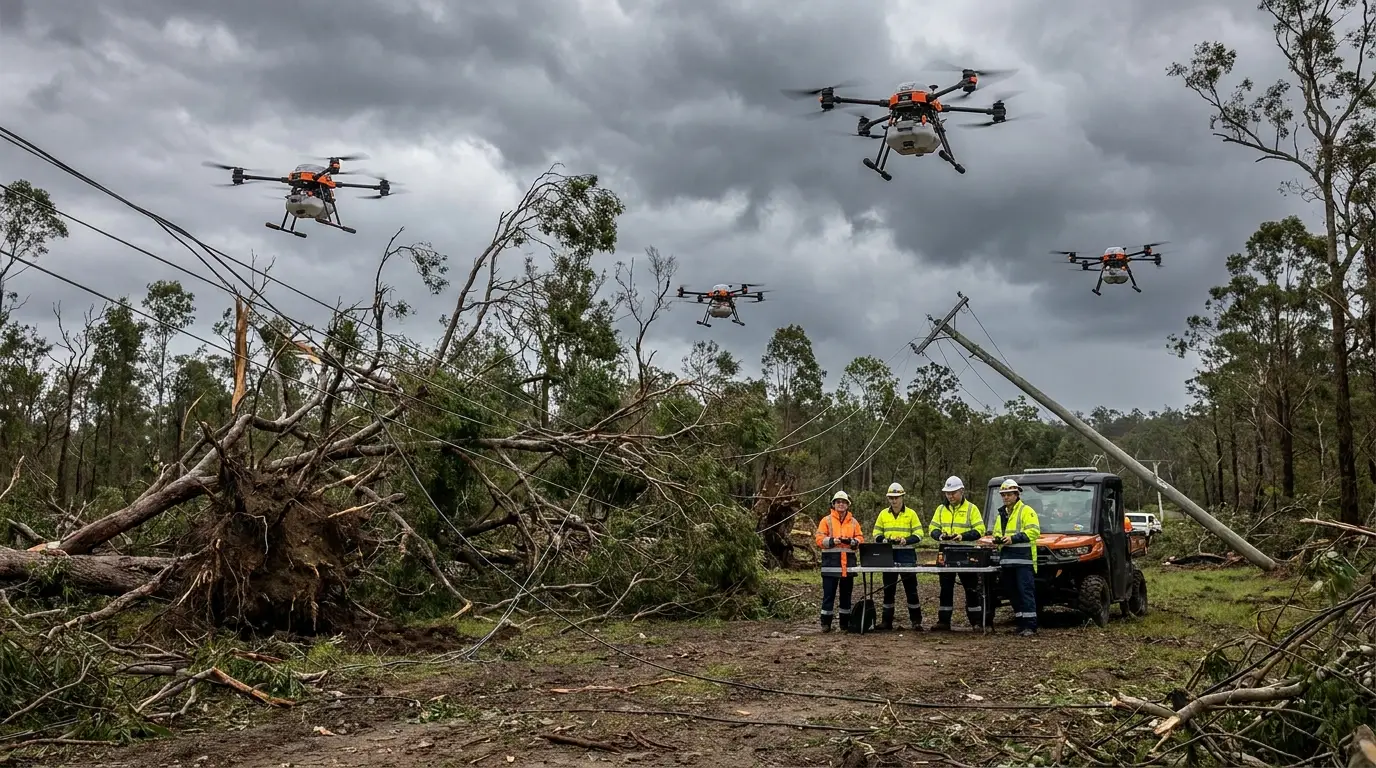
Rapid Post-Storm Powerline Damage Assessment with Drones in India
When severe weather strikes—be it the fierce monsoons, cyclonic storms, or unseasonal heavy rains that frequently impact various regions of India—power outages are an almost inevitable consequence. These outages cripple communities, halt businesses, and pose significant challenges to daily life. The immediate priority for utility companies is to identify the extent of damage to their vast power transmission and distribution networks and restore power as quickly and safely as possible. Traditionally, this has been a laborious, hazardous, and time-consuming process, often involving manual ground patrols or helicopter inspections over challenging terrain.
Looking for a provider? AiRotor Labs offers transmission line drone inspection services across India — thermal, LiDAR and corona inspection of live lines, ₹5,000–₹15,000 per km.
However, the advent of drone technology has revolutionized this critical post-storm response. At AiRotor Labs, we leverage state-of-the-art drones to conduct rapid, accurate, and safe post-storm powerline damage assessment, drastically cutting down restoration times and enhancing operational efficiency for utility providers across India. This blog post outlines our comprehensive drone response workflow, detailing how we help bring power back faster after an emergency.
The Urgent Need for Rapid Assessment in the Indian Context
India's geographical diversity, from dense urban sprawls to remote rural areas, mountainous regions, and extensive coastlines, makes its power grid particularly vulnerable to varied weather phenomena. Monsoons, in particular, bring heavy rainfall and strong winds, frequently leading to fallen trees, snapped conductors, damaged insulators, and structural integrity issues with towers and poles.
The challenges with traditional assessment methods are significant:
- Safety Risks: Manual ground teams face dangers from live wires, unstable structures, flooded areas, and difficult-to-access terrain.
- Time Consumption: Surveying hundreds or thousands of kilometers of power lines manually can take days or even weeks, prolonging outages. Helicopters, while faster, are expensive, require specific weather conditions, and cannot provide the granular detail drones offer.
- Accessibility: Many affected areas become inaccessible due to flooding, landslides, or damaged roads, further delaying assessment.
- Incomplete Data: Manual visual inspections can miss subtle damage or issues in hard-to-reach spots.
Drones address these challenges head-on. They can safely navigate hazardous environments, cover vast distances rapidly, access remote locations, and capture highly detailed data, making them indispensable for efficient post-storm powerline damage assessment.
Pre-Deployment Planning & DGCA Compliance
A successful drone operation begins long before takeoff. For post-storm powerline damage assessment in India, meticulous planning and strict adherence to Directorate General of Civil Aviation (DGCA) regulations are paramount.
- Initial Damage Reports & Prioritization: Upon notification from a utility client, we gather initial reports on affected regions. This helps us prioritize areas based on outage severity, population density, and critical infrastructure.
- Route Mapping & Flight Planning: Our expert team maps out precise flight paths, considering the powerline corridors, terrain, potential obstacles, and the required data resolution. We pre-plan flight altitudes, speeds, and camera overlaps to ensure comprehensive coverage.
- Team Mobilization: We deploy certified drone pilots, visual observers, and ground support staff equipped with necessary safety gear and communication tools.
- DGCA Compliance: This is a non-negotiable step in India. All our drones are registered, have valid Unique Identification Numbers (UINs), and are operated by licensed pilots holding valid Remote Pilot Certificates. For every mission, especially in emergency scenarios, we ensure adherence to the Digital Sky platform guidelines. This includes obtaining necessary flight permissions, especially for operations in "Yellow Zones," and strictly avoiding "Red Zones" unless specific, high-level clearances are obtained. Our team is well-versed in navigating these regulatory requirements, ensuring legal and safe operations even under urgent circumstances.
- Risk Assessment: A thorough on-site risk assessment is conducted to identify immediate hazards like downed lines, unstable structures, and environmental factors, ensuring the safety of both the drone crew and the public.
Drone-Based Data Acquisition Workflow
The core of our service lies in our advanced data acquisition capabilities. We deploy a fleet of robust, industrial-grade drones equipped with specialized sensors tailored for infrastructure inspection.
Sensor Selection:
- High-Resolution RGB Cameras: These are crucial for visual inspection, capturing clear, detailed images of physical damage such as snapped conductors, broken insulators, damaged cross-arms, leaning poles/towers, and vegetation encroachment. Our drones can zoom in to detect even minor hairline cracks or corrosion.
- Thermal (Infrared) Cameras: Thermal imaging is invaluable for identifying hotspots, which indicate loose connections, overloaded components, or internal damage not visible to the naked eye. This helps in pinpointing areas of overheating that could lead to future failures if not addressed during repairs.
- LiDAR (Light Detection and Ranging) Scanners: For complex terrain or dense vegetation, LiDAR provides highly accurate 3D point clouds. This data allows for precise measurement of conductor sag, vegetation clearance analysis (identifying trees dangerously close to lines), and detailed structural integrity assessment of towers and poles, even under challenging lighting conditions or through light foliage.
- RTK/PPK GNSS Systems: Our drones are equipped with Real-Time Kinematic (RTK) or Post-Processed Kinematic (PPK) Global Navigation Satellite System (GNSS) technology, ensuring centimeter-level accuracy (typically 1-3 cm horizontal, 2-5 cm vertical) in data collection. This precision is vital for accurate damage localization and subsequent repair planning.
Automated Flight Execution: Once the flight plan is uploaded, drones execute automated missions along the powerline corridors. This ensures consistent data capture, optimal overlaps between images/scans, and maximum efficiency. Our pilots maintain visual line of sight (VLOS) or operate under specific BVLOS (Beyond Visual Line of Sight) permissions where applicable and safe, continuously monitoring the drone's status and real-time data feed.
Real-Time Monitoring: During flights, ground teams monitor live video feeds and sensor data, allowing for immediate identification of significant damage and on-the-fly adjustments to the flight plan for closer inspection of critical areas.
Data Processing & Analysis
Raw data collected by drones is just the beginning. The real value comes from sophisticated processing and analysis.
- Data Ingestion & Pre-processing: Captured images, thermal data, and LiDAR point clouds are ingested into specialized software platforms. This involves georeferencing, aligning, and stitching data to create a comprehensive digital representation of the surveyed corridor.
- Orthomosaic & 3D Model Generation: High-resolution RGB images are processed to create georeferenced orthomosaic maps of the powerline corridor. For towers and critical structures, detailed 3D models (point clouds or mesh models) are generated, allowing for virtual inspection from any angle.
- Thermal Anomaly Detection: Thermal data is analyzed to identify and quantify temperature anomalies. Automated algorithms can highlight hotspots, making it quicker to pinpoint potential failure points.
- LiDAR Data Analysis: LiDAR point clouds are used for precise vegetation encroachment analysis, clearance violation detection, sag and tension calculations, and detailed structural measurements of towers and conductors. This helps identify structural weaknesses or changes caused by the storm.
- AI-Powered Defect Detection: We employ advanced AI and machine learning algorithms to automate the detection of common defects such as broken insulators, damaged components, corrosion, and conductor anomalies. This significantly speeds up the analysis phase, allowing our human experts to focus on complex or ambiguous findings.
- GIS Integration: All processed data—orthomosaics, 3D models, defect locations, and measurements—are integrated into a Geographic Information System (GIS). This allows utility companies to overlay drone data with their existing network maps, providing a holistic view of the damage.
Reporting & Remediation
The final stage translates raw data and analysis into actionable intelligence, empowering utility companies to execute repairs efficiently.
- Comprehensive Damage Reports: We deliver detailed, georeferenced reports that clearly outline every identified damage point. Each report includes:
- Precise GPS coordinates of the damage.
- High-resolution images (RGB and thermal) or 3D views of the defect.
- A clear description of the damage type and severity.
- Recommended remedial actions.
- Quantified measurements (e.g., sag, clearance distances from LiDAR data).
- Interactive Dashboards: For larger projects, we can provide interactive web-based dashboards where utility engineers can visualize the entire surveyed network, filter damage by type or severity, and track the progress of repairs.
- Prioritization for Repair Crews: By providing an accurate, detailed map of all damage, utility companies can effectively prioritize repair efforts, dispatching crews to the most critical areas first and ensuring they arrive with the right equipment and materials. This targeted approach dramatically reduces the overall outage duration.
- Post-Repair Verification: Drones can also be deployed post-repair to verify the quality of work and ensure that all identified issues have been adequately addressed, contributing to the long-term resilience of the power grid.
Conclusion
The aftermath of a storm demands a swift, safe, and precise response to restore power. Traditional methods for post-storm powerline damage assessment are often inadequate for the scale and urgency required in India. AiRotor Labs offers a cutting-edge drone-based solution that transforms this critical process. By leveraging advanced sensors, meticulous planning, DGCA-compliant operations, and intelligent data analysis, we provide utility companies with the actionable insights they need to minimize downtime, reduce risks to personnel, and enhance grid resilience.
Our commitment is to empower India's energy sector with the most efficient and reliable drone inspection services, ensuring communities get back on their feet faster after nature's fury.
Ready to secure your power grid against future storm impacts? Contact AiRotor Labs today to discuss how our drone inspection services can benefit your operations.
Book a Consultation with AiRotor Labs
AiRotor Labs provides drone-based inspection, aerial survey, and land survey across India.
Book a consultation →