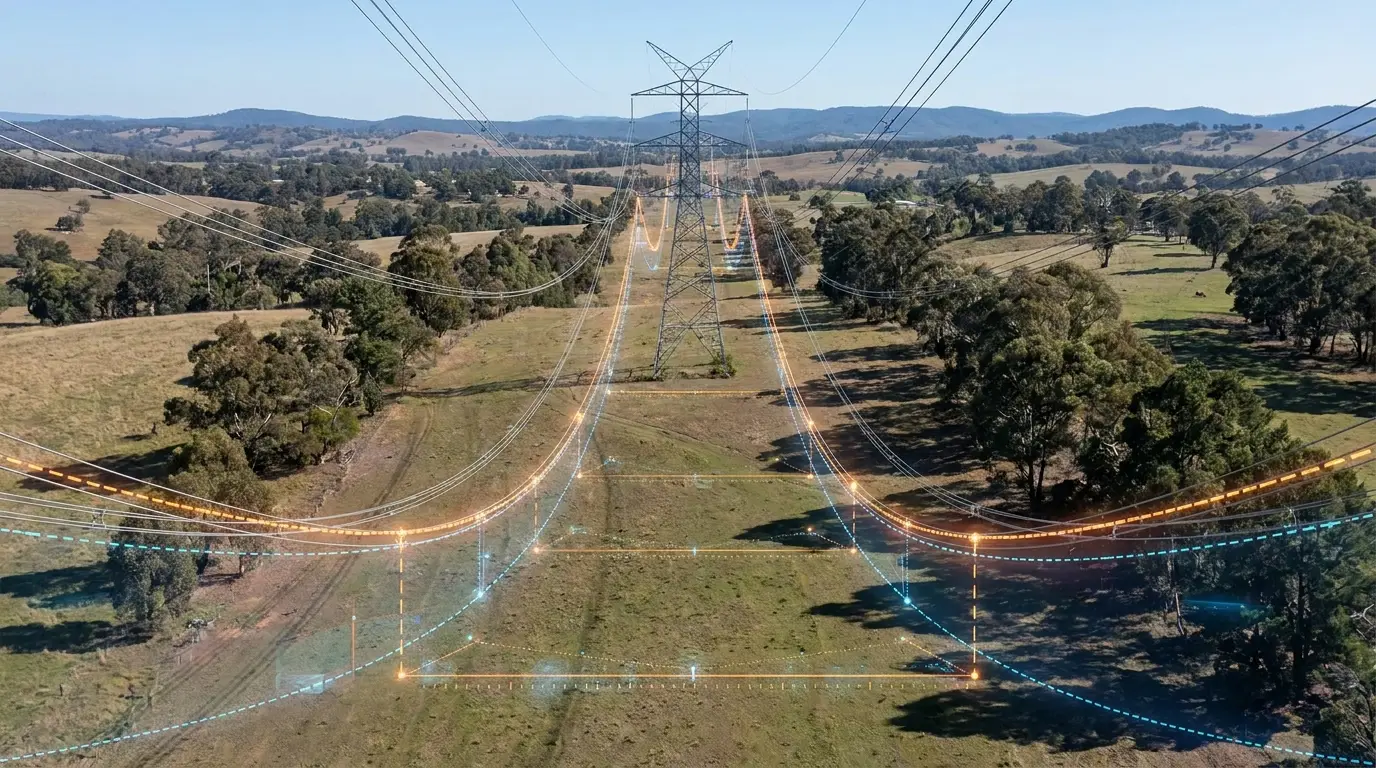
Precision Sag & Clearance Measurement of Transmission Lines with Drone Photogrammetry
India's rapidly expanding economy and growing population demand an uninterrupted and reliable power supply. At the heart of this supply chain are vast networks of transmission lines, silently channeling electricity across diverse terrains. Ensuring the integrity and optimal performance of these lines is paramount, not just for power delivery but also for public safety and operational efficiency. A critical aspect of this maintenance is the accurate sag and clearance measurement of transmission lines. Historically, this has been a challenging, time-consuming, and often dangerous task. However, the advent of drone photogrammetry is transforming how power companies approach this vital inspection, offering unparalleled precision, speed, and safety.
Looking for a provider? AiRotor Labs offers transmission line drone inspection services across India — thermal, LiDAR and corona inspection of live lines, ₹5,000–₹15,000 per km.
Why Sag and Clearance Are Non-Negotiable for India's Power Grid
Before diving into the drone solution, it's essential to understand the significance of sag and clearance.
Sag refers to the downward dip or curve of a transmission line conductor between two support towers. It's a natural phenomenon influenced by factors like conductor material, tension, span length, and crucially, temperature. As temperatures rise, conductors expand and sag more; as they cool, they contract and sag less.
Clearance is the vertical or horizontal distance between the transmission line conductor and any object below or beside it – this could be the ground, vegetation, buildings, roads, or other infrastructure.
Why are these measurements so critical, especially in the Indian context?
- Safety: Insufficient clearance can lead to devastating consequences, including flashovers, electrocution risks for humans and animals, and wildfires, particularly in dry seasons.
- Reliability: Excessive sag reduces the distance between conductors, increasing the risk of inter-phase flashovers, especially during high winds or extreme weather events like monsoons, leading to power outages.
- Transmission Capacity: Maintaining optimal sag ensures the line operates within its designed parameters, preventing overheating and maximizing power transfer efficiency.
- Regulatory Compliance: In India, the Central Electricity Authority (CEA) specifies strict regulations for sag and clearance values. Non-compliance can result in penalties and operational disruptions.
- Environmental Factors: India's diverse climate, from scorching summers that increase sag to heavy monsoons that promote rapid vegetation growth, makes consistent monitoring indispensable.
Accurate sag and clearance measurement of transmission lines is therefore not just a best practice; it's a foundational requirement for a robust and safe power infrastructure.
The Limitations of Traditional Inspection Methods
For decades, power utilities have relied on conventional methods, each with significant drawbacks:
- Ground-Based Visual Inspections: Teams walk the line, visually estimating sag and clearance. This is slow, highly susceptible to human error, and often impossible in dense vegetation, hilly terrain, or inaccessible areas common across India.
- Manual Measurement: Involves personnel using measuring tapes or laser rangefinders, often requiring line shutdowns for safety. This method is extremely dangerous, slow, and provides only point measurements, lacking a comprehensive view.
- Helicopter Inspections: While faster than ground patrols, helicopters are expensive to operate, generate a high carbon footprint, are noisy, and pose safety risks. More importantly, they offer limited precision for detailed sag and clearance measurement of transmission lines and are primarily suited for broad visual assessments rather than precise engineering data.
These traditional methods fall short in providing the precise, repeatable, and safe data required for modern grid management. They are reactive rather than proactive, often identifying problems only after they have escalated.
Drone Photogrammetry: A Revolution in Transmission Line Inspection
Enter drone photogrammetry – a game-changer for transmission line management. This technology leverages Unmanned Aerial Vehicles (UAVs) equipped with high-resolution cameras to capture thousands of overlapping images of the transmission corridor. These images, each tagged with precise GPS coordinates, are then fed into specialized photogrammetry software.
Here’s how it works for sag and clearance measurement of transmission lines:
- Data Acquisition: Drones fly pre-programmed routes along the transmission lines, capturing high-resolution, georeferenced photographs. For survey-grade accuracy, we typically deploy RTK (Real-Time Kinematic) or PPK (Post-Processed Kinematic) enabled drones. These systems correct GPS data in real-time or post-flight using ground control stations or base station data, ensuring centimeter-level positional accuracy for each image.
- Sensor Technology: AiRotor Labs utilizes professional-grade drones equipped with high-resolution full-frame or medium-format cameras (e.g., 45MP+ sensors). These sensors capture intricate details, making it possible to identify individual strands of a conductor and accurately model the terrain.
- 3D Model Generation: The photogrammetry software (such as Pix4Dmapper, Agisoft Metashape, or Bentley ContextCapture) processes these images. It identifies common points across multiple images to reconstruct a highly accurate 3D model of the transmission corridor. This model typically includes:
- Dense Point Cloud: Millions of precisely located 3D points representing the conductors, towers, ground, and surrounding vegetation.
- Orthomosaic Map: A georeferenced, high-resolution 2D map of the area, free from distortion.
- 3D Mesh Model: A textured 3D representation.
- Measurement and Analysis: Engineers can then extract precise measurements directly from this 3D model. Specialized tools within the software or dedicated analysis platforms allow for:
- Sag Measurement: Calculating the exact vertical distance between the lowest point of the conductor and a straight line connecting its attachment points on the towers.
- Clearance Measurement: Determining the precise vertical and horizontal distances from the conductors to the ground, vegetation, structures, or any other obstruction.
- Vegetation Encroachment: Identifying and quantifying vegetation growth that infringes on the safety clearance zones.
- Tower Integrity: Analyzing tower lean, structural damage, or component deterioration.
This comprehensive 3D data provides an unprecedented level of detail and accuracy, moving beyond mere visual inspection to quantitative engineering analysis.
Achieving Unprecedented Precision: Accuracy and Efficiency
The benefits of drone photogrammetry for sag and clearance measurement of transmission lines extend far beyond safety:
- Superior Accuracy: With RTK/PPK drones and meticulous ground control points (GCPs) when necessary, absolute accuracy of the 3D model can be typically within 2-5 cm. Relative accuracy (measurements within the model) can be even finer, often sub-2 cm. This level of precision is virtually unattainable with traditional methods and crucial for meeting stringent CEA regulations.
- Enhanced Safety: Drone operations eliminate the need for personnel to work at height or in close proximity to live lines, drastically reducing risks of accidents and electrocution.
- Dramatic Efficiency: Drones can cover vast stretches of transmission lines in a fraction of the time compared to ground crews or helicopters. A single drone team can inspect several kilometers of line in a day, acquiring data that would take weeks using traditional methods. This translates to significantly reduced operational downtime for power companies.
- Cost-Effectiveness: While there's an initial investment in drone services, the long-term cost savings are substantial. Reduced personnel hours, fewer equipment rentals, minimized safety risks, and proactive maintenance leading to fewer outages all contribute to a lower total cost of ownership compared to recurring traditional inspections.
- Comprehensive Data Archive: The 3D models and associated data provide a permanent, georeferenced record of the transmission line's condition at a specific time. This data is invaluable for trend analysis, predictive maintenance, regulatory audits, and future planning.
- DGCA Compliance: All drone operations in India are governed by the Directorate General of Civil Aviation (DGCA) regulations. AiRotor Labs operates with all necessary Unmanned Aircraft Operator Permits (UAOP), Unique Identification Numbers (UINs) for drones, and adheres strictly to Standard Operating Procedures (SOPs), ensuring all inspections are conducted legally and safely within the Indian airspace.
Beyond Measurement: Comprehensive Data and Predictive Maintenance
While the primary focus here is on sag and clearance measurement of transmission lines, drone photogrammetry offers a holistic view of the transmission corridor. The same flight data can be used to:
- Identify Vegetation Encroachment: Precisely map and quantify vegetation growth within the right-of-way, allowing for targeted and efficient trimming operations.
- Assess Structure Integrity: Detect subtle damage, corrosion, or deformation in towers, insulators, and other components that might be missed during a visual inspection.
- Monitor Land Use Changes: Track development or topographical changes along the corridor that could impact future clearance.
- Facilitate Predictive Maintenance: By regularly monitoring sag, clearance, and component health, power companies can transition from reactive repairs to proactive, data-driven maintenance strategies. This prevents failures, extends asset life, and optimizes resource allocation.
The detailed, actionable insights derived from drone photogrammetry empower utilities to make informed decisions, ensuring the long-term reliability and safety of India's critical power infrastructure.
AiRotor Labs brings cutting-edge drone technology and expertise to power companies and infrastructure developers across Ahmedabad and India. Our specialized services for transmission line inspection, including precise sag and clearance measurement of transmission lines with drone photogrammetry, are designed to enhance your operational efficiency, safety, and compliance.
Ready to transform your transmission line inspection strategy with unparalleled precision and safety? Contact AiRotor Labs today to discuss your specific requirements and learn how our drone solutions can benefit your operations.
Book Your Drone Inspection Service Now
Sag and clearance measurement is typically delivered alongside our transmission line inspection services.
AiRotor Labs provides drone-based inspection, aerial survey, and land survey across India.
Book a consultation →