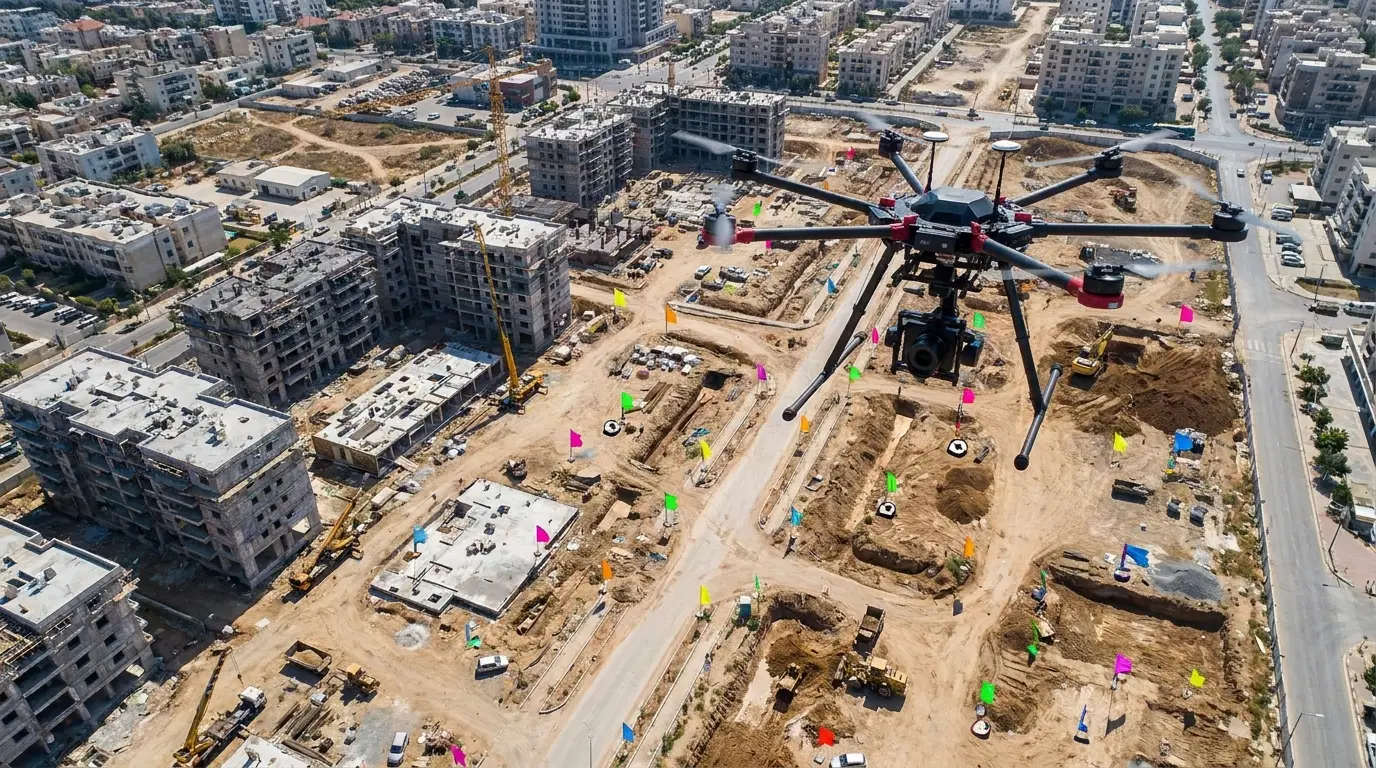
Precision Topographical Mapping with Drones for Real Estate & Construction
India's real estate and construction sectors are booming, driven by rapid urbanization, infrastructure development, and a growing economy. With projects becoming increasingly complex and timelines tighter, the demand for accurate, timely, and cost-effective site data has never been higher. Traditional methods of land surveying, while foundational, often struggle to keep pace with these demands. This is where topographical mapping with drones emerges as a transformative solution, offering unprecedented levels of detail, speed, and safety for developers, contractors, and project managers across the nation.
Looking for a provider? AiRotor Labs offers drone land survey and mapping services across India — photogrammetry and LiDAR with RTK/PPK accuracy, from ₹800 per acre.
Understanding the terrain is the first, most critical step in any construction or development project. From initial site selection to final earthwork, precise topographical data informs every decision. Drones have fundamentally changed how this data is acquired, processed, and utilized, delivering insights that were once either too expensive, too time-consuming, or too dangerous to obtain.
The Evolution of Site Intelligence: From Traditional to Drone Mapping
For decades, topographical mapping relied heavily on manual ground surveys, involving teams of surveyors with Total Stations, GPS receivers, and measuring tapes. While accurate, these methods are inherently slow, labour-intensive, and often expose personnel to hazardous conditions, especially on large, complex, or active sites. Data collection could take weeks or even months for expansive areas, leading to project delays and increased costs. Furthermore, the density of data points was often limited, potentially missing crucial details that could impact design and execution.
The advent of drones has ushered in a new era for topographical mapping with drones. These unmanned aerial vehicles (UAVs) can cover vast areas in a fraction of the time, collecting millions of data points with remarkable precision. This shift is not just about speed; it's about generating a richer, more comprehensive dataset that empowers better decision-making at every stage of a project. For the dynamic Indian market, where project timelines are aggressive and land parcels often irregular, this efficiency is invaluable.
The Science Behind Drone-Based Topographical Mapping
The magic of drone-based topographical mapping lies in its sophisticated technology, primarily leveraging two key methods: photogrammetry and LiDAR.
Photogrammetry: This involves capturing hundreds, sometimes thousands, of overlapping high-resolution images of the terrain from various angles. Specialized software then processes these images, stitching them together to create a detailed 3D model of the site. This process generates:
- Orthomosaic Maps: Georeferenced, high-resolution aerial images, perfect for site planning and visual inspection.
- Digital Surface Models (DSMs): Representing the earth's surface including all objects on it (buildings, trees, etc.).
- Digital Terrain Models (DTMs): A 'bare earth' model, showing only the ground elevation, crucial for earthwork calculations and hydrological analysis.
- Contour Maps: Lines connecting points of equal elevation, providing a clear visual representation of the terrain's slope and shape.
LiDAR (Light Detection and Ranging): For projects requiring extreme accuracy or involving dense vegetation, LiDAR is the preferred choice. A LiDAR sensor emits pulses of laser light and measures the time it takes for each pulse to return. This creates a highly accurate 3D 'point cloud' of the environment. Unlike photogrammetry, LiDAR can penetrate through foliage, providing an accurate representation of the ground beneath trees, which is invaluable for greenfield projects or sites with significant vegetation cover.
To ensure centimeter-level accuracy, modern survey-grade drones are equipped with RTK (Real-Time Kinematic) or PPK (Post-Processed Kinematic) GPS technology. These systems correct GPS errors in real-time or post-flight, drastically reducing the need for numerous Ground Control Points (GCPs) and significantly enhancing the precision of the resulting maps and models. Typically, with RTK/PPK and a few strategically placed GCPs, horizontal accuracies of 2-5 cm and vertical accuracies of 3-10 cm can be achieved, meeting stringent engineering requirements.
Unlocking Efficiency: Benefits for Indian Real Estate & Construction
The advantages of adopting topographical mapping with drones are substantial for the Indian construction and real estate sectors:
- Unmatched Speed and Timeliness: Drones can survey hundreds of acres in a single day, compared to weeks for traditional methods. This rapid data acquisition means project managers get critical information faster, accelerating initial planning, design iterations, and construction phases. In a market where time is money, this efficiency is a game-changer.
- Significant Cost Savings: While there's an initial investment in drone services, the overall cost savings are considerable. Reduced labor hours, fewer delays, minimized rework due to inaccurate data, and precise material quantity estimations contribute to a healthier project budget.
- Superior Accuracy and Detail: The high-resolution data captured by drones provides an unparalleled level of detail. Millions of data points result in highly accurate DTMs, DSMs, and contour maps, essential for precise earthwork calculations, drainage planning, and structural design. This precision minimizes errors and costly revisions down the line.
- Enhanced Safety: Drones eliminate the need to send personnel into potentially hazardous areas such as steep slopes, active construction zones, or sites with unstable ground. This significantly reduces the risk of accidents and improves overall site safety.
- Comprehensive Data for Better Decisions: Beyond simple elevation data, drones provide a rich visual context. Orthomosaic maps offer a current, detailed bird's-eye view, aiding in site logistics, progress monitoring, and stakeholder communication. This holistic data empowers more informed and confident decision-making.
Practical Applications & Regulatory Compliance in India
The applications of drone-based topographical mapping are diverse and impactful across the real estate and construction lifecycle:
- Site Selection and Feasibility Studies: Before breaking ground, detailed topographical maps help assess land suitability, identify potential challenges like drainage issues or steep gradients, and optimize site layout. This is crucial in India where land parcels can vary significantly in terrain and existing features.
- Design and Planning: Engineers and architects rely on accurate DTMs and contour maps to design foundations, roads, utilities, and grading plans. Precise cut-and-fill volumes can be calculated, optimizing earthmoving operations and material costs.
- Progress Monitoring and Quality Control: Regular drone surveys allow for continuous monitoring of construction progress, comparing actual site conditions against design plans. This helps identify deviations early, track earthwork volumes, and ensure compliance with specifications.
- Volumetric Calculations: For projects involving large quantities of materials (e.g., aggregates, excavated soil, stockpiles), drones provide highly accurate volumetric measurements. This is invaluable for inventory management, billing, and ensuring efficient material handling.
- Land Acquisition and Boundary Demarcation: In a country with complex land records, drone surveys can provide clear, verifiable evidence of land features and boundaries, aiding in land acquisition processes and resolving potential disputes.
- Infrastructure Development: For linear projects like roads, railways, and pipelines, drones offer efficient corridor mapping, elevation profiling, and obstacle identification.
DGCA Regulations in India: It is vital to note that drone operations in India are strictly regulated by the Directorate General of Civil Aviation (DGCA). Any commercial drone operation, including topographical mapping, requires adherence to these rules. This includes:
- Drone Registration: All drones must have a Unique Identification Number (UIN).
- Pilot Certification: Drone pilots must possess a valid Remote Pilot Certificate.
- Operational Authorization: Specific permissions (e.g., UAOP - Unmanned Aircraft Operator Permit or RPAS Authorization) are required for commercial flights, especially in controlled airspace.
- Flight Zones: Adherence to "Red," "Yellow," and "Green" zones for flight permissions.
Choosing a drone service provider like AiRotor Labs ensures that all operations are conducted in full compliance with DGCA regulations, guaranteeing legal, safe, and professional service.
Why Choose AiRotor Labs for Your Topographical Mapping Needs?
At AiRotor Labs, located in Ahmedabad, we understand the specific challenges and opportunities within India's real estate and construction sectors. We combine cutting-edge drone technology with deep geographical expertise to deliver precise, actionable topographical data.
Our team comprises DGCA-certified pilots and experienced geomatics engineers who meticulously plan each mission, deploy state-of-the-art drones equipped with high-resolution RGB cameras or LiDAR sensors, and utilize advanced processing software. We ensure that our data products – from detailed orthomosaic maps and DTMs to precise contour lines and volumetric reports – are tailored to meet your project's unique requirements and integrate seamlessly with your existing workflows.
By partnering with AiRotor Labs, you gain a reliable partner committed to enhancing your project efficiency, reducing risks, and providing the accurate insights necessary for successful project delivery, all while adhering to the highest safety and regulatory standards set by the DGCA.
Ready to revolutionize your real estate or construction project with advanced topographical mapping? Contact AiRotor Labs today to discuss your specific requirements and discover how our drone services can provide you with the precision and efficiency you need.
Unlock the power of aerial intelligence for your next project. Visit https://www.airotor.in/booking to schedule a consultation.
AiRotor Labs provides drone-based inspection, aerial survey, and land survey across India.
Book a consultation →