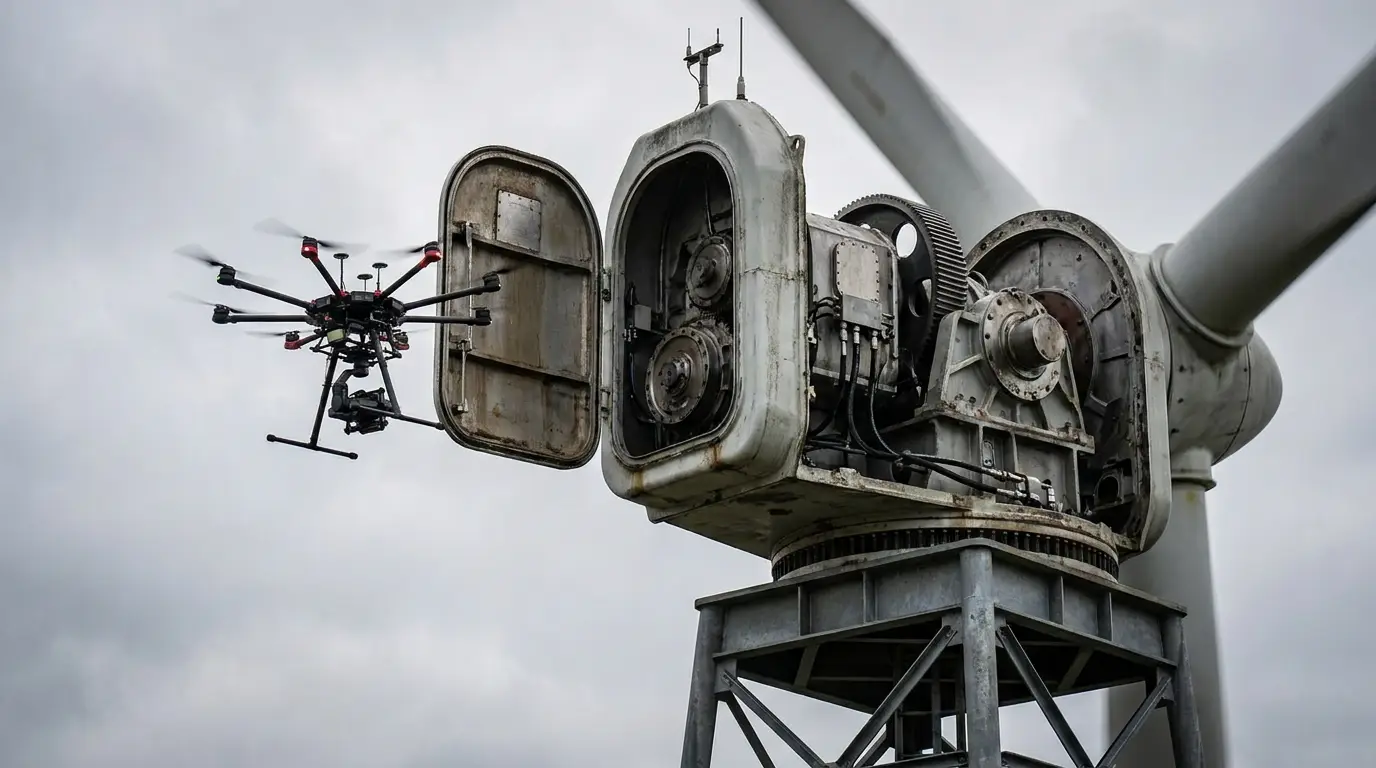
Optimizing Wind Turbine Performance: Nacelle & Gearbox Inspection Using Industrial Drones
India's renewable energy sector is booming, with wind power playing a pivotal role in our transition to sustainable energy. As the number of wind farms grows, so does the critical need for efficient, safe, and accurate maintenance strategies. At the heart of every wind turbine lie the nacelle and gearbox – complex, vital components responsible for converting wind energy into electricity. Ensuring their optimal health is paramount to maximizing energy output, minimizing downtime, and extending the lifespan of these multi-million-rupee assets.
Traditionally, inspecting these high-altitude components has been a challenging, time-consuming, and often hazardous task, relying on rope access teams or expensive crane-based platforms. However, the advent of industrial drones has ushered in a new era of inspection, transforming how we approach wind turbine nacelle and gearbox inspection using industrial drones. This technology offers an unparalleled combination of safety, speed, and precision, making it an indispensable tool for wind farm operators across India.
The Criticality of Nacelle and Gearbox Health
The nacelle, often described as the "engine room" of the wind turbine, houses the gearbox, generator, controller, and other essential machinery. The gearbox, in particular, is a high-stress component that steps up the slow rotation of the turbine blades to the much faster speed required by the generator. Given the constant forces, vibrations, and operational stresses they endure, these components are highly susceptible to wear and tear.
Even minor defects – a hairline crack in the nacelle casing, a loose bolt, a lubricant leak, or an overheating bearing within the gearbox – can escalate quickly into catastrophic failures. Such failures not only lead to extensive downtime and colossal repair costs but also pose significant safety risks and result in substantial energy production losses. Proactive, regular inspection is not just good practice; it's essential for operational sustainability and profitability. Traditional methods, while thorough, often face limitations in terms of accessibility, speed, and the sheer human effort required, making comprehensive and frequent inspections difficult to execute.
How Industrial Drones Revolutionize Wind Turbine Inspection
Industrial drones have fundamentally changed the paradigm for inspecting wind turbine nacelles and gearboxes. By deploying advanced unmanned aerial vehicles (UAVs), inspection teams can now gather high-resolution data from every angle of these towering structures without ever leaving the ground.
The primary advantages are clear:
- Enhanced Safety: Eliminates the need for personnel to work at hazardous heights or in confined spaces, drastically reducing accident risks.
- Speed and Efficiency: A full inspection of a nacelle and gearbox can often be completed in a fraction of the time compared to traditional methods – typically a few hours per turbine instead of days. This minimizes turbine downtime, allowing for quicker return to energy generation.
- Superior Data Quality: Drones equipped with specialized sensors capture incredibly detailed visual and thermal data, providing a level of insight often unattainable through manual checks.
- Cost-Effectiveness: While there's an initial investment in drone technology and expertise, the long-term savings from reduced downtime, prevented major failures, and lower labor costs are significant.
- Consistency and Repeatability: Automated flight paths ensure consistent data capture over time, facilitating accurate trend analysis and predictive maintenance.
This shift means that wind turbine nacelle and gearbox inspection using industrial drones is no longer a niche service but a mainstream, highly effective approach for modern wind farm management.
Advanced Sensors and Technology for Detailed Analysis
The effectiveness of drone-based inspection hinges on the sophistication of the payloads they carry. For comprehensive nacelle and gearbox assessment, a combination of advanced sensors is crucial:
High-Resolution RGB Cameras: These are the workhorses for visual inspections. Industrial drones are typically equipped with 4K or even 8K resolution cameras capable of capturing stunningly detailed images and videos. This allows inspectors to identify:
- Cracks, corrosion, or pitting on the nacelle casing.
- Loose or missing bolts and fasteners.
- Oil or lubricant leaks (which often appear as streaks or stains).
- Damage to ventilation grilles or exhaust systems.
- Wear on external components like anemometers or wind vanes.
- The high pixel density enables the detection of anomalies as small as a few millimeters from a safe standoff distance.
Radiometric Thermal Cameras (Infrared): Perhaps the most critical sensor for detecting internal component issues without direct contact. Thermal cameras, such as those from FLIR, measure infrared radiation emitted by objects, translating it into a visual heat map. This is invaluable for:
- Gearbox Overheating: Early detection of elevated temperatures in specific areas of the gearbox can indicate failing bearings, insufficient lubrication, or internal component friction long before a visual symptom appears. Temperature differentials of even a few degrees Celsius can signal a developing problem.
- Generator Issues: Overheating in the generator can also be detected.
- Electrical Faults: Hot spots in electrical cabinets or connections within the nacelle.
- Insulation Degradation: Areas with compromised insulation will often show abnormal thermal signatures. Radiometric cameras provide precise temperature readings for each pixel, allowing for quantitative analysis and comparison over time.
Lidar (Light Detection and Ranging): While primarily used for 3D mapping and terrain modeling, LiDAR can also be employed for highly accurate dimensional measurements of the nacelle structure. This can help detect subtle deformations or structural integrity issues that might not be immediately obvious in 2D images. However, for internal gearbox issues, thermal and visual remain the primary diagnostic tools.
These sensors are integrated onto robust, industrial-grade drones designed for stability in challenging wind conditions, ensuring stable data capture even at significant heights.
The Inspection Process and Data Analysis Workflow
A typical drone-based wind turbine nacelle and gearbox inspection using industrial drones follows a structured workflow to ensure comprehensive coverage and actionable insights:
- Mission Planning: Before flight, detailed flight plans are generated using specialized software. These plans outline automated flight paths around the nacelle, ensuring consistent overlap for data stitching and full coverage. Considerations include turbine type, specific areas of focus (e.g., ventilation ports, access hatches), weather conditions (wind speed, visibility), and adherence to local regulations.
- On-site Execution: A DGCA-certified drone pilot conducts pre-flight checks and deploys the drone. The drone autonomously or semi-autonomously executes the planned mission, capturing hundreds of high-resolution visual and thermal images from various angles. A typical inspection for a single nacelle and gearbox can be completed in approximately 1-3 hours, depending on the turbine size and complexity.
- Data Processing: The captured raw data is then processed using advanced software. Photogrammetry software stitches the visual images into a comprehensive 3D model or orthomosaic map of the nacelle. Thermal images are analyzed using specialized thermal inspection software to identify hot spots, temperature differentials, and potential anomalies.
- Expert Analysis and Reporting: Experienced analysts review the processed data, identifying defects, categorizing their severity, and pinpointing their exact locations. Detailed reports are generated, including annotated images (both visual and thermal), defect descriptions, GPS coordinates, and recommendations for maintenance or further investigation. This report serves as a crucial tool for maintenance planning and decision-making for wind farm operators.
Navigating the Indian Landscape: DGCA Regulations and Market Context
For drone operations in India, adherence to the Directorate General of Civil Aviation (DGCA) regulations is paramount. Any drone service provider, including AiRotor Labs, must comply with strict guidelines:
- Remote Pilot License (RPL): All drone pilots must possess a valid RPL issued by a DGCA-approved flying school.
- Drone Registration: All drones must be registered and possess a Unique Identification Number (UIN) and an Unmanned Aircraft Operator Permit (UAOP) for commercial operations.
- No Permission, No Take-off (NPNT): Drones must operate with NPNT compliance, requiring prior permission for every flight through the DigitalSky platform.
- Restricted Airspaces: Awareness and strict avoidance of no-fly zones and restricted airspaces around airports, military installations, and sensitive government areas.
At AiRotor Labs, we ensure full compliance with all DGCA regulations, providing our clients with legal, safe, and professional drone services.
The Indian wind energy market is expanding rapidly, with states like Gujarat, Rajasthan, Tamil Nadu, and Maharashtra leading the charge. As India targets ambitious renewable energy goals, the demand for efficient Operations & Maintenance (O&M) solutions for wind farms will only intensify. Drone-based inspection offers a distinct advantage for Indian operators by:
- Reducing O&M Costs: Lowering labor costs and the expense of specialized equipment like cranes.
- Improving Asset Uptime: Faster inspections lead to quicker identification of issues and reduced downtime.
- Extending Asset Life: Proactive maintenance based on accurate data prevents premature component failures.
- Enhancing Safety Standards: Aligning with international best practices for worker safety.
This makes wind turbine nacelle and gearbox inspection using industrial drones not just a technological advancement, but a strategic imperative for India's wind energy future.
Conclusion
The health of a wind turbine's nacelle and gearbox is non-negotiable for efficient energy production. Industrial drones offer a transformative solution for their inspection, delivering unparalleled safety, speed, and data fidelity compared to traditional methods. By leveraging high-resolution visual and radiometric thermal cameras, wind farm operators can gain deep insights into the operational status of their assets, identify potential issues early, and implement proactive maintenance strategies.
At AiRotor Labs, we are at the forefront of this revolution in India, providing expert drone-based inspection services fully compliant with DGCA regulations. Our team of certified pilots and data analysts is equipped with state-of-the-art industrial drones and advanced processing capabilities to help you optimize your wind energy assets, ensure their longevity, and maximize your return on investment.
Ready to enhance the reliability and efficiency of your wind farm? Learn more about our specialized drone inspection services for wind turbines.
Contact AiRotor Labs today to schedule a consultation or book an inspection. Visit us at https://www.airotor.in/booking and let us help you harness the power of aerial intelligence.
AiRotor Labs provides drone-based inspection, aerial survey, and land survey across India.
Book a consultation →