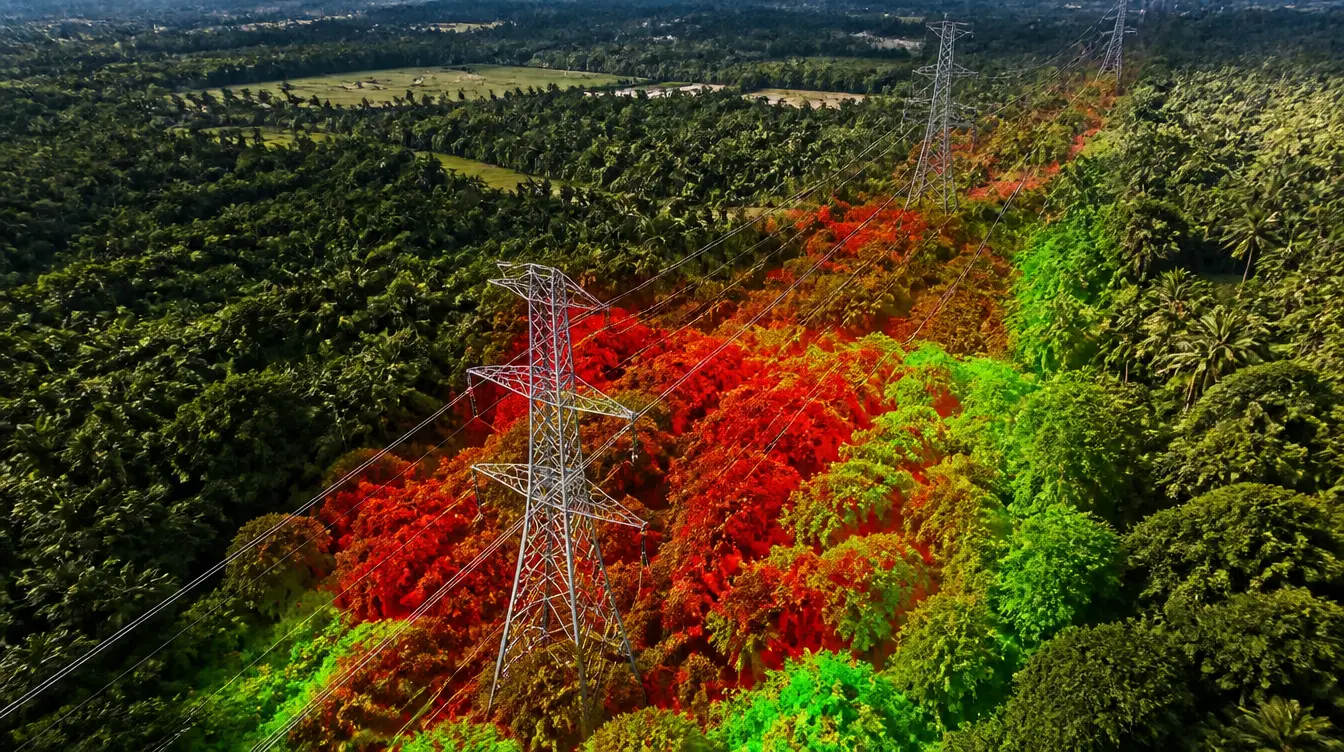
Enhanced Vegetation Encroachment Monitoring for Powerlines with Multispectral Drones
For India's rapidly expanding energy sector, maintaining the integrity and reliability of power transmission and distribution networks is paramount. A silent yet persistent threat to this infrastructure is vegetation encroachment. Trees and foliage growing too close to powerlines can lead to devastating consequences: power outages, equipment damage, increased fire risks, and significant safety hazards for both personnel and the public. Traditional methods of identifying and managing these encroachments are often slow, dangerous, and resource-intensive, making proactive maintenance a significant challenge across the vast and diverse Indian landscape.
Looking for a provider? AiRotor Labs offers transmission line drone inspection services across India — thermal, LiDAR and corona inspection of live lines, ₹5,000–₹15,000 per km.
However, a revolutionary approach is transforming how power utility companies address this issue: vegetation encroachment monitoring on powerline corridors with multispectral drones. This technology offers an unprecedented level of detail, efficiency, and safety, allowing for precise, data-driven vegetation management strategies that were once unimaginable.
The Persistent Threat: Why Vegetation Encroachment Matters for Powerlines
Powerline corridors, designed to provide a clear path for electricity transmission, are constantly under siege from nature. In India, factors like rapid vegetation growth, especially during the monsoon season, diverse topographies ranging from dense forests to agricultural lands, and even urban expansion, mean that vegetation can quickly become a critical problem.
The risks associated with unchecked vegetation growth are multifaceted:
- Power Outages: The most immediate and common consequence. Contact between powerlines and vegetation can cause short circuits, leading to widespread power disruptions. This impacts industries, homes, and critical services, incurring substantial economic losses.
- Safety Hazards: Live electrical lines coming into contact with trees pose severe electrocution risks to anyone in the vicinity, including maintenance workers and the general public.
- Wildfire Risk: Dry vegetation near powerlines is a significant fire hazard, especially in hot, arid regions or during extended dry spells. A single spark can ignite a devastating forest fire, threatening lives, property, and natural ecosystems.
- Equipment Damage: Arcing between lines and vegetation can damage insulators, conductors, and other crucial components, necessitating expensive repairs and replacements.
- Increased Maintenance Costs: Reactive maintenance, responding to outages after they occur, is far more costly and disruptive than proactive management. Traditional manual inspections and clearing operations are also labor-intensive and expose crews to hazardous environments.
Given these challenges, power utility companies need a solution that is not only effective at identifying threats but also efficient, safe, and scalable across India's extensive network.
Beyond Visible Light: Understanding Multispectral Technology for Vegetation
To truly understand and manage vegetation, we need to see beyond what the human eye can perceive. This is where multispectral imaging comes into play. Unlike standard RGB (Red, Green, Blue) cameras that capture visible light, multispectral sensors collect data across several distinct spectral bands, including those invisible to us, such as Near-Infrared (NIR) and Red Edge.
Here’s how these bands provide critical insights:
- Red, Green, Blue (RGB): Provides standard visual imagery, useful for mapping and general identification.
- Near-Infrared (NIR): Healthy vegetation strongly reflects NIR light. This band is crucial for assessing plant vigor and biomass.
- Red Edge: This narrow band, located between visible red and NIR, is highly sensitive to changes in chlorophyll content, making it excellent for detecting early signs of plant stress or subtle variations in species.
By analyzing the reflectance values in these different bands, we can calculate various vegetation indices, such as the Normalized Difference Vegetation Index (NDVI). A higher NDVI value typically indicates healthier, denser vegetation, while lower values can point to stressed plants or different species. This detailed spectral information allows for:
- Species Identification: Different plant species have unique spectral signatures, enabling differentiation between fast-growing invasive species and slower-growing, less problematic vegetation.
- Health Assessment: Identify vegetation that is particularly vigorous and thus likely to grow quickly into the corridor, or conversely, stressed vegetation that might be dying and pose a different kind of risk.
- Density Mapping: Accurately map the density of vegetation, helping prioritize clearing efforts.
This granular understanding of vegetation is fundamental to effective vegetation encroachment monitoring on powerline corridors with multispectral drones.
How Multispectral Drones Revolutionize Powerline Corridor Monitoring
Integrating multispectral sensors with advanced drone platforms offers an unparalleled solution for powerline corridor management. Here’s a breakdown of the process and its advantages:
- Data Acquisition: High-end commercial drones, equipped with professional-grade multispectral cameras (e.g., Micasense RedEdge series, DJI Mavic 3 Multispectral), fly pre-programmed routes along powerline corridors. These drones can cover vast distances quickly and safely, often capturing data for tens of kilometers in a single day.
- Advanced Sensors & Accuracy: Modern multispectral sensors capture high-resolution imagery, typically at ground sample distances (GSD) of a few centimeters per pixel. This allows for precise identification of individual trees and even smaller saplings. When combined with accurate GPS data and photogrammetric processing, the resulting maps can achieve horizontal accuracies down to sub-meter levels, and even centimeter-level vertical accuracy for canopy height measurements.
- Data Processing & Analytics: The captured multispectral data is then processed using specialized software. This involves stitching individual images into large orthomosaic maps, generating 3D point clouds, and creating various vegetation index maps (like NDVI, NDRE, etc.).
- Actionable Insights: Our expert analysts interpret these maps to identify areas of concern. We can pinpoint specific trees or clusters of vegetation that are encroaching or have the potential to encroach upon the powerline safety buffer. This includes:
- Encroachment Hotspots: Areas where vegetation is already too close.
- Growth Prediction: Identifying fast-growing species or dense vegetation that will soon become a problem.
- Canopy Height Models: Precisely measuring the height of vegetation relative to the powerlines.
- Change Detection: Comparing current data with previous surveys to monitor growth rates and evaluate the effectiveness of past clearing operations.
- GIS Integration: All data and analysis are delivered in formats compatible with Geographic Information Systems (GIS), allowing power companies to integrate the drone data seamlessly into their existing asset management systems for ongoing monitoring and planning.
This approach transforms reactive maintenance into proactive, predictive management, significantly enhancing the efficiency and effectiveness of vegetation encroachment monitoring on powerline corridors with multispectral drones.
Key Benefits & Indian Contextual Advantages
The shift to drone-based multispectral monitoring brings a host of benefits, particularly relevant to the Indian operational landscape:
- Proactive Risk Mitigation: Identify potential issues long before they escalate into outages or safety hazards. This allows for scheduled, targeted clearing operations rather than emergency responses.
- Significant Cost Savings: Reduce reliance on costly and time-consuming manual ground patrols. Optimize vegetation clearing budgets by targeting only necessary areas, minimizing unnecessary cutting. Fewer outages also translate to substantial financial savings.
- Enhanced Safety: Remove human personnel from hazardous proximity to high-voltage lines and difficult terrain. Drones can access areas that are dangerous or inaccessible to ground crews, ensuring worker safety.
- Improved Operational Efficiency: Cover hundreds of kilometers of corridor in a fraction of the time compared to traditional methods. Data acquisition for a typical 50-100 km corridor, for instance, might take 2-3 days of flight time, followed by 5-7 days for comprehensive data processing and report generation.
- Data-Driven Decision Making: Move beyond subjective assessments to precise, quantifiable data. This ensures that vegetation management strategies are based on accurate information, leading to more effective and sustainable solutions.
- Compliance and Reporting: Generate detailed reports and visual evidence for regulatory compliance, internal auditing, and stakeholder communication.
- Addressing India's Unique Challenges:
- Monsoon Season: Rapid growth during monsoons makes continuous monitoring crucial. Drones can quickly assess post-monsoon vegetation surges.
- Diverse Terrain: From the Himalayas to the Western Ghats, India's varied geography makes ground access difficult. Drones navigate these terrains with ease.
- Urban-Rural Interface: As cities expand, powerlines often run through newly developed areas, requiring frequent monitoring for new encroachments.
Furthermore, AiRotor Labs strictly adheres to the Directorate General of Civil Aviation (DGCA) regulations for commercial drone operations in India. This includes ensuring all pilots are certified, drones are registered and maintained, and necessary flight permissions are obtained for each operation, guaranteeing fully compliant and legal services.
Implementing a Drone-Based Vegetation Monitoring Program with AiRotor Labs
Partnering with AiRotor Labs means leveraging cutting-edge technology and deep expertise to secure your powerline infrastructure. Our process is designed to be seamless and deliver actionable intelligence:
- Consultation & Scope Definition: We begin by understanding your specific powerline network, operational challenges, and vegetation management goals.
- Customized Flight Planning: Our experts develop a detailed flight plan, optimizing routes and sensor settings for maximum data capture efficiency and accuracy over your specified corridors.
- Data Acquisition: Our DGCA-certified drone pilots deploy advanced multispectral drone systems to collect high-resolution imagery and spectral data.
- Advanced Data Processing & Analysis: Using state-of-the-art photogrammetry and GIS software, we process the raw data to generate orthomosaic maps, 3D models, and a suite of vegetation indices. Our analysts then interpret this data to identify all potential encroachment risks.
- Actionable Reports & Recommendations: You receive comprehensive reports detailing encroachment hotspots, vegetation health assessments, growth predictions, and clear recommendations for targeted clearing operations. These reports are integrated with easy-to-use maps and visual data for quick understanding.
- Ongoing Support: We offer recurring monitoring programs to track vegetation growth over time, allowing for continuous optimization of your management strategies.
With AiRotor Labs, you gain a partner dedicated to enhancing the safety, reliability, and efficiency of your power transmission assets through intelligent, drone-powered solutions.
Secure Your Powerlines, Secure India's Future
The integrity of India's power grid is non-negotiable. By adopting advanced drone-based multispectral technology for vegetation encroachment monitoring on powerline corridors, power utility companies can move towards a more resilient, safer, and cost-effective operational model. AiRotor Labs is at the forefront of this revolution, providing the expertise and technology to transform your vegetation management challenges into strategic advantages.
Ready to explore how multispectral drones can safeguard your powerline infrastructure? Visit us at airotor.in or contact us today to discuss your specific requirements.
Optimize your powerline corridor management with AiRotor Labs. Book a consultation now: https://www.airotor.in/booking
AiRotor Labs provides drone-based inspection, aerial survey, and land survey across India.
Book a consultation →