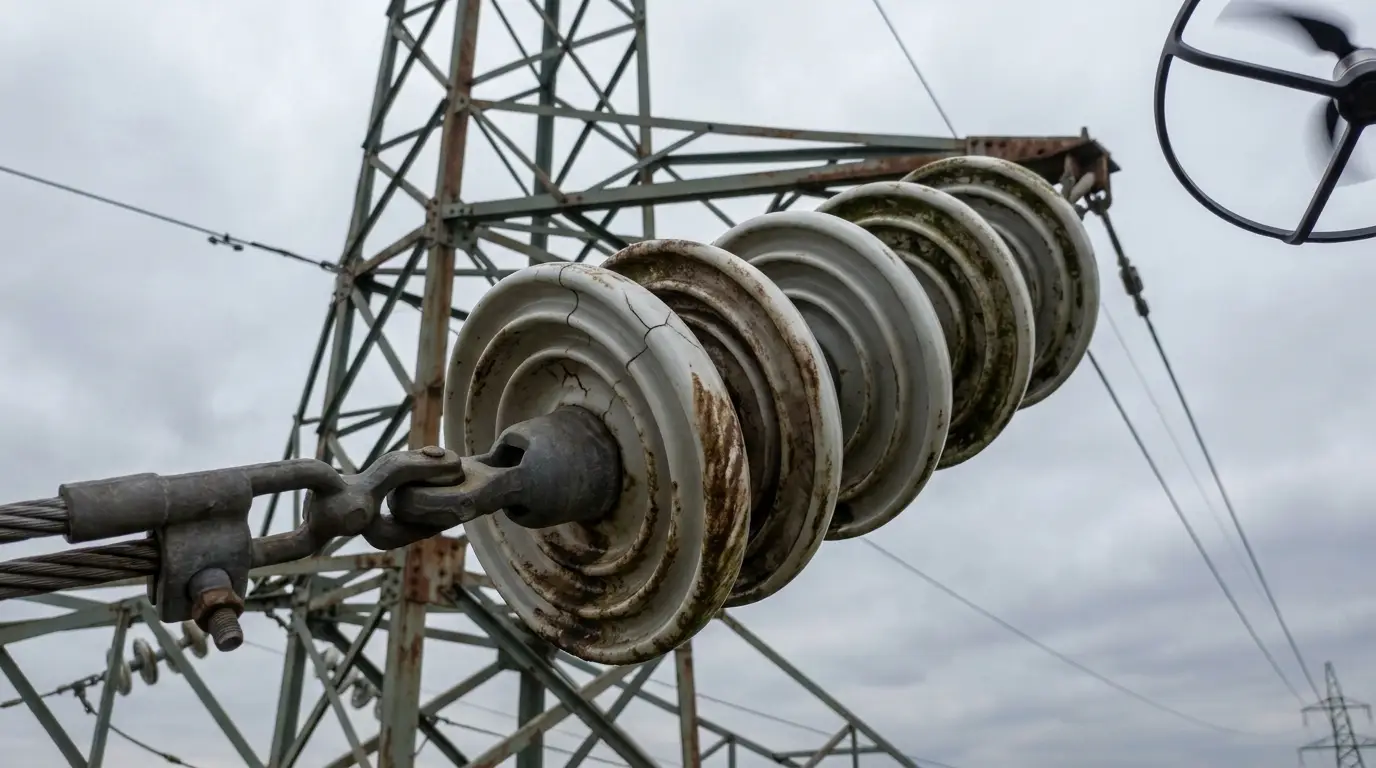
Precision and Safety: Drone-Based Insulator Defect Detection on High-Voltage Transmission Lines
India's energy backbone relies heavily on an expansive network of high-voltage transmission lines, stretching across diverse terrains from bustling urban centres to remote rural landscapes. These lines are the lifeblood of our economy, and their uninterrupted operation is paramount. At the heart of their reliability are insulators – critical components that prevent current leakage and mechanically support the conductors. However, these insulators are constantly exposed to environmental stresses, leading to defects that can compromise grid stability, cause costly outages, and pose significant safety risks.
Looking for a provider? AiRotor Labs offers transmission line drone inspection services across India — thermal, LiDAR and corona inspection of live lines, ₹5,000–₹15,000 per km.
Traditionally, inspecting these vital components involved manual climbing, ground observations with binoculars, or expensive helicopter surveys. These methods are inherently dangerous, time-consuming, labour-intensive, and often lack the precision needed for early defect identification. In a country like India, with its vast and challenging infrastructure, a more efficient, safer, and accurate solution is not just beneficial, but essential. This is where advanced drone technology, specifically drone-based insulator defect detection on high-voltage transmission lines, steps in as a game-changer.
The Critical Role of Insulators and the Limitations of Traditional Inspection
Insulators are designed to withstand extreme electrical and mechanical stresses, ensuring that electricity flows safely through the conductors without leaking to the tower structure. Over time, factors like pollution, moisture, UV radiation, lightning strikes, and even bird activity can degrade insulators, leading to surface contamination, cracks, chipping, or internal degradation. Such defects can result in flashovers, energy loss, and eventually, catastrophic failures that disrupt power supply to millions.
The traditional approaches to inspecting these defects come with significant drawbacks:
- Safety Risks: Sending personnel to climb high-voltage towers is extremely dangerous, exposing them to risks of electrocution, falls, and heat exhaustion, especially in India's varied climate.
- Accessibility Challenges: Many transmission lines traverse difficult terrain – dense forests, mountains, or marshlands – making ground access for manual inspections arduous and time-consuming.
- Time and Cost: Manual inspections are slow, requiring extensive planning and manpower. Helicopter inspections, while faster, are prohibitively expensive and environmentally impactful.
- Limited Accuracy: Visual inspections from a distance, even with binoculars, often miss subtle yet critical defects. Helicopters fly at higher altitudes, further limiting detailed observation.
- Live Line Restrictions: Many traditional methods require power line shutdowns, leading to costly downtime and service interruptions.
Given the sheer scale of India's transmission network, these limitations translate into substantial operational inefficiencies and increased risk of grid instability.
How Drones Revolutionize Insulator Inspection
Unmanned Aerial Vehicles (UAVs), or drones, have emerged as the ideal solution to overcome the inherent challenges of traditional power line inspection. By deploying drones, companies like AiRotor Labs can perform detailed, close-range inspections of high-voltage transmission lines and their components, including insulators, without exposing personnel to danger or requiring power shutdowns.
The shift to drone technology for insulator inspection offers several compelling advantages:
- Enhanced Safety: Drones eliminate the need for human climbers on towers, drastically reducing accident risks.
- Speed and Efficiency: Drones can cover significantly more ground in a fraction of the time compared to manual methods, often inspecting 20-30 km of line per day, versus 1-2 km manually. This translates to faster identification of issues and quicker remedial action.
- Cost-Effectiveness: While there's an initial investment in technology, the long-term operational savings from reduced labour costs, faster inspections, and avoided outages are substantial.
- Superior Data Quality: Equipped with advanced sensors, drones capture high-resolution data that provides a level of detail unattainable through traditional visual inspections.
- Minimal Disruption: Inspections can often be conducted on live lines, avoiding costly power outages and ensuring continuous service.
These benefits collectively make drone-based insulator defect detection on high-voltage transmission lines a superior, safer, and more reliable method for maintaining India's critical power infrastructure.
The Technology Behind Drone-Based Insulator Defect Detection
The true power of drone inspection lies in the sophisticated sensor payloads they carry, specifically chosen for their ability to detect different types of insulator defects:
Thermal Cameras (Infrared):
- Function: These cameras detect subtle temperature variations on the insulator surface. A healthy insulator should maintain a consistent temperature profile.
- Defect Detection: Internal cracks, moisture ingress, contamination, or localized degradation increase electrical resistance, causing hot spots. Thermal imaging can pinpoint these anomalies with high sensitivity (often detecting differences in millikelvin), indicating potential points of failure long before they become visible to the naked eye. This is crucial for identifying overheating connections or internal breakdown.
High-Resolution RGB Cameras:
- Function: Equipped with powerful optical zoom lenses, these cameras capture incredibly detailed visual images and videos of the insulators.
- Defect Detection: They are essential for identifying physical damage such as chipped porcelain, cracked composite materials, flashover traces, severe contamination build-up, bird nesting, corrosion on metal fittings, or vandalism. The ability to zoom in from a safe distance allows for sub-millimeter detail capture, crucial for accurate visual assessment.
Corona Cameras (UV Cameras):
- Function: These specialized cameras detect ultraviolet (UV) emissions that occur during partial discharges, commonly known as corona activity.
- Defect Detection: Corona discharge is an electrical phenomenon that happens when the electric field strength around a conductor exceeds a certain threshold, ionizing the air. It often indicates surface degradation, sharp edges, or contamination on insulators, acting as an early warning sign of impending insulation breakdown. Detecting corona allows for proactive maintenance before it escalates into a flashover or complete failure.
Beyond data acquisition, the process involves advanced data analytics. AiRotor Labs leverages AI and machine learning algorithms to process the vast amounts of captured imagery and thermal data. This automation helps in rapidly identifying defects, classifying their severity, and geo-tagging their exact location. This automated analysis significantly reduces human error and accelerates the reporting process, providing actionable insights to utility operators.
The AiRotor Labs Advantage: Precision, Safety, and Compliance in India
At AiRotor Labs, we understand the unique challenges and operational landscape of India's power sector. Our approach to drone-based insulator defect detection on high-voltage transmission lines is built on three pillars: precision, safety, and strict regulatory compliance.
- Uncompromising Safety: Our primary concern is safety. By deploying advanced drones, we eliminate the need for human presence in hazardous environments, protecting personnel from electrocution, falls, and other tower-related risks. All our operations are meticulously planned to ensure maximum safety for both our teams and the surrounding environment.
- Efficiency and Accuracy Tailored for India: We deploy state-of-the-art drones equipped with a combination of thermal, RGB, and corona cameras, ensuring comprehensive data capture. Our pilots are DGCA (Directorate General of Civil Aviation) certified, experienced in navigating India's diverse geographical and climatic conditions – from the deserts of Rajasthan to the humid coasts and mountainous regions. This ensures consistent data quality and efficient coverage, significantly reducing inspection timelines and providing highly accurate defect reports.
- DGCA Compliance: Operating drones in India requires strict adherence to DGCA regulations. AiRotor Labs is fully compliant with all Indian drone laws, including obtaining necessary flight permissions, maintaining certified pilot licenses, and adhering to designated flight zones. This ensures that all our operations are legal, safe, and integrated seamlessly with local authorities and operational protocols.
- Actionable Insights: Our detailed reports include precise geo-referenced images and thermal maps of defects, severity assessments, and recommended actions. This allows power utilities to move from reactive repairs to proactive, predictive maintenance, optimizing resource allocation and extending the lifespan of critical assets.
Beyond Detection: Predictive Maintenance and Cost Savings
The true value of advanced drone-based insulator defect detection on high-voltage transmission lines extends far beyond merely identifying faults. It fundamentally transforms maintenance strategies from reactive to predictive. By detecting nascent issues like partial discharges or minor hot spots on insulators, utilities can schedule repairs during planned outages, preventing unexpected and costly failures.
This proactive approach leads to significant cost savings:
- Reduced Outage Costs: Preventing unscheduled outages saves utilities from substantial revenue losses, penalty fees, and the high cost of emergency repairs.
- Optimized Maintenance Budgets: By understanding the exact condition of their assets, utilities can prioritize repairs, allocate resources more effectively, and avoid unnecessary maintenance on healthy components.
- Extended Asset Lifespan: Addressing minor defects early prevents their escalation into major damage, thereby extending the operational life of insulators and other grid components.
- Improved Grid Reliability: A healthier transmission network translates to more stable and reliable power delivery, crucial for India's growing industrial and domestic energy demands.
Investing in drone-based inspection is not just about technology; it's about investing in the long-term resilience and efficiency of India's power infrastructure.
Partner with AiRotor Labs for a Smarter Grid
The future of high-voltage transmission line inspection is here, and it's airborne. AiRotor Labs is committed to empowering India's power sector with cutting-edge drone technology for safer, faster, and more accurate asset management. Our expertise in drone-based insulator defect detection on high-voltage transmission lines ensures that your infrastructure remains robust, reliable, and ready to meet the nation's energy demands.
Don't let undetected defects compromise your operations. Partner with AiRotor Labs to harness the power of aerial intelligence and transform your maintenance strategy.
Ready to enhance the safety and reliability of your transmission lines? Visit our website to learn more or book a consultation with our experts.
Book Your Drone Inspection Today!
Insulator inspection is one part of a wider corridor programme — see our transmission line inspection services for the full scope.
AiRotor Labs provides drone-based inspection, aerial survey, and land survey across India.
Book a consultation →